
Saturday, May 9, 2026
Home Blog Page 40

How a Lack of Data Governance Is Blocking Enterprise AI Adoption

0

When we speak of ‘AI’, our minds today gravitate towards the growing list of powerful models that providers like OpenAI and Meta have brought to center stage over the past 12 months. We know AI and LLMs can fundamentally transform modern business as we know it, but many obstacles are still present. At the end of the day, as the infamous AI expert Andrew Ng reminds us, ‘AI = Model + Data.’

The past 15 years of AI breakthroughs have been weighted far more heavily towards the ‘model’ component of this AI equation, and with the recent widespread adoption of large language models (LLMs), companies now find themselves gifted with some of the most powerful algorithms we have ever seen. But what about the data?

A culinary analogy is helpful here: Let’s say that ‘Meal = Chef + Ingredients.’ The current breakthroughs in AI that we are witnessing are akin to some serious upskilling of the chef. But, no matter how high-performing this chef becomes, problems that exist in the raw ingredients themselves will always impair the resulting quality of the meal prepared. The same goes for data.

As enterprises in 2023 race to get ahead of the Generative AI (GenAI) adoption curve, it is becoming clear that most are indeed very far from having the right data foundation in place to support the reliable adoption of LLMs, particularly in a scalable way.

Whilst quality and controls around structured data (e.g., numerical tables of data) have always been a top-of-mind subject for data leaders, the rise of LLMs in 2022 has meant that, for the first time, unstructured data can be leveraged for countless AI applications. Unstructured data refers to anything from text-based documents like contracts, policies or market reports, to files such as videos, images and audio recordings. Such data is the core ingredient for the plethora of chatbots, smart knowledge assistants and content-generation engines that companies are eager to deploy, and yet has rarely received any attention from a data governance perspective.

The familiar scene for unstructured data in most companies looks like thousands upon thousands of documents spread far and wide across every corner of the organization, from file-sharing systems like Dropbox and SharePoint to clusters of data homed in the cloud to myriad documents gathering dust in legacy systems or local folders. A historic lack of systematic management of such data is creating three big challenges that must be addressed to unlock reliable usage of AI: data relevance, data quality and data safety.

Data Relevance

LLMs are intelligent but need a lot of hand-holding in order to sift through thousands of documents and select the most relevant source to infer an answer from. Take an insurance company that has deployed a knowledge assistant trained on the masses of insurance policies they possess. Given that policies vary in subtle ways based on anything from geography to accident type to customer profile, it is very challenging to ensure that an answer returned from the knowledge assistant will have been retrieved from a document that reflects the exact contextual knowledge of a given question.

Data Quality

Data quality in the context of unstructured data is still a highly unexplored subject. Standard approaches for assessing outliers, freshness, completeness, etc., of tabular datasets no longer hold true in this new paradigm, but the same problems exist.

What happens if I ask my chatbot to tell me something about “CompanyX,” but the ideal dataset to use actually has the naming convention “CompX?” What happens when I have conflicting information across many documents? What if the sea of data I am feeding into a model contains outdated reports or those will become obsolete over time?

Data Safety

Last but by no means least is the subject of data safety. Companies require measures to ensure that sensitive information, ranging from Personal Identifiable Information (PII) to proprietary data and IP, cannot be exposed to models.

Take GDPR in Europe: a company could spend millions of dollars training its own proprietary customer support model and unknowingly include a document containing a customer’s address. Should this customer request for their data to be removed, then the organization would have no choice but to delete the entire model.

Beyond external data sharing, many companies are also struggling to maintain data access controls within the organization itself. This is particularly true for knowledge assistants or chatbots, where enforcing guardrails around which employees can access which pieces of data via the model is a big sticking point.

So What Can Companies Do?

Organizations serious about adopting LLMs require a clear strategy for their unstructured data that addresses the three areas above. They can work on these challenges in-house, which often is a heavy investment both in time and money. However, a new crop of highly skilled companies are coming to market with true industry expertise in these areas.

There are a number of new companies addressing this problem with deep expertise, so let’s take a look at a couple that are doing innovative work in the space. Deasie is a data governance startup built by former McKinsey/QuantumBlack employees who focus on intelligently tagging thousands of documents across a company with key themes, including document purpose, version, and the types of PII present. Another example is Kobalt Labs, which built a model-agnostic API that anonymizes and replaces PII and other sensitive data from structured and unstructured input, allowing enterprises to use third-party models like ChatGPT safely and securely.

With the pace of advancement in the world of GenAI, it is tempting to feel that companies are on the brink of a wide-scale AI transformation. But, whilst these models offer a tremendous opportunity, any meaningful progress towards the adoption of this technology must be accompanied by a robust and thoughtful data management strategy. Data governance is coming out of the Trough of Disillusionment of the Gartner hype cycle and the enterprises that get ahead of their data governance now can be winners in the long run.

The Newsweek Expert Forum is an invitation-only network of influential leaders, experts, executives, and entrepreneurs who share their insights with our audience.What’s this?Content labeled as the Expert Forum is produced and managed by Newsweek Expert Forum, a fee based, invitation only membership community. The opinions expressed in this content do not necessarily reflect the opinion of Newsweek or the Newsweek Expert Forum.


Eight phrases to avoid when communicating during a crisis

0

A crisis can showcase what a business is truly made of. In business, challenges can arise at any moment, and each and every step leaders take to tackle obstacles has a direct impact on brand perception. Communication in these situations is crucial to keeping stakeholders at all levels informed and maintaining calm in the midst of a storm.

The right communication can result in increased brand loyalty from both internal and external stakeholders, but even just one communication misstep can cause irreparable damage to a business’s reputation. To help leaders share information with care, eight Newsweek Expert Forum members each share one word or phrase businesses should avoid using when communicating during a crisis and what to say and do instead to drive forward movement.

1. ‘No Comment’

Crisis management emerged as the most important process in public relations during the 1980s. When a crisis arises within a business, saying or doing nothing or the wrong thing can erode trust and damage reputations. To maintain transparency and trust with stakeholders and the public during a crisis, businesses should avoid using the phrase “no comment,” which can seem evasive and uncooperative. – Lillian Gregory, The 4D Unicorn LLC

2. ‘Unforeseen Circumstances’

The phrase “unforeseen circumstances” can come off as evasive and suggests a lack of preparedness. In a crisis, stakeholders seek accountability and clarity. Using vague terms can erode trust and confidence in the company’s leadership. – Ian Wilding, Hangar 75

3. ‘No Immediate Danger’

In times of crisis, businesses should avoid using the phrase “no immediate danger” as it can create a false sense of security, potentially downplaying the gravity of the situation and leading stakeholders to underestimate the necessary response or preparations. During crises, being transparent and acknowledging the full scope of the issue fosters trust and preparedness. – Anna Yusim, MD, Yusim Psychiatry, Consulting & Executive Coaching

4. ‘Business as Usual’

Avoid the term “business as usual.” In a crisis situation, this phrase can erode people’s trust. It projects a lack of accountability and denial. Instead, adopt the principle of reflective transparency. This is both a psychological double play and a communication method that not only acknowledges the severity of the crisis, but also lays out steps that a business will take to resolve the matter. – Dr. Kira Graves, Kira Graves Consulting

5. ‘But’

In a crisis, using “but” comes across as making excuses and diminishes your credibility at a time when transparency and honesty are key. While you might believe this word balances your message by presenting both sides of an argument, it really gives the impression that you are ducking blame. – Gergo Vari, Lensa

6. ‘Everything Will Be All Right’

Avoid saying “Everything will be all right.” Offering this phrase gives a false sense of security. In the midst of a crisis, there are often complex layers to the problem which have yet to surface. As the scenario unfolds, companies will uncover many things, major and minute that will then negatively impact other things. These issues may unfortunately not be fixable, or at least not in the way some stakeholders expect. – Vonda Wright, L2 Defense, Inc.

7. ‘If We’

When sharing your company’s perspective on a misstep during a crisis communication, not using the phrase “if we” shows solidarity and ownership. Often, when in a scenario that requires an apology, having that out instead of clearly stating the misstep can create more distrust and possibly land as insensitive. – André Blackman, Onboard Health

8. ‘We Did Our Best’

Don’t say you did your best. When a crisis arises, it is clear that it happened because we weren’t prepared. In business, we constantly need to anticipate the worst-case scenario, and if we still get into some difficult situations, we need to own our mistakes and start focusing on the next steps to move on. – Krisztina Veres, Veres Career Consulting

The Newsweek Expert Forum is an invitation-only network of influential leaders, experts, executives, and entrepreneurs who share their insights with our audience.What’s this?Content labeled as the Expert Forum is produced and managed by Newsweek Expert Forum, a fee based, invitation only membership community. The opinions expressed in this content do not necessarily reflect the opinion of Newsweek or the Newsweek Expert Forum.

How to minimize that "sinking feeling" during plane take-off, from a pilot

0

Hate that nauseating feeling you get when a plane takes off? Choosing the right seat on a plane can help with this, according to Kyle Koukol, a 29-year-old airline pilot based in San Francisco.

Koukol flies a Boeing 737 aircraft for a commercial airline. He told Newsweek that the “sinking feeling” passengers experience can be minimized, depending on where you sit on the aircraft.

Understanding the mechanics of what’s happening at take-off may also help calm any nerves about flying.

In a viral clip posted in late July from @dial_a_pilot—the TikTok account of Dial A Pilot, a company founded by Koukol—the pilot unpacked what’s happening with the plane at take-off.

A message overlaid on the clip reads: “Hate flying and really hate take-off? Watch this.”

Dial A Pilot allows nervous flyers to book 15-minute calls with a pilot who can provide information to help ease their nerves about flying.

If you suffer from a fear of flying, you’re not alone. The fear was found to be prevalent among around 10 to 40 percent of the industrialized world, according to a June 2021 study in Frontiers in Psychology.

An April 2019 in the peer-reviewed journal Aerospace Medicine and Human Performance found that the “fear of flying is one of the most common phobias” and “even though flight traffic has increased, there are new fears.”

According to the study, which analyzed flight anxiety reported from 1986 to 2015, “turbulence, unknown sounds, and fear of terror attacks caused the most anxiety.” More women reported being afraid of both flying and other situations compared to men.

How To Minimize That ‘Sinking Feeling’ on a Plane

The footage in the viral post shows a view of the plane wing from a window seat as it accelerates down a runway. The video was captured while Koukol was flying a Boeing 757 aircraft, he says in the clip.

Wonder why you get that “sinking feeling” during take-off? Koukol said that this is actually “the airplane changing its angle as it goes into the wind,” which results in feeling like “you’re just sinking there for a minute,” especially in the back of the plane.

If you’re looking to mitigate the effect of that “sinking feeling” at take-off, then “the front of the airplane is definitely a dampered experience versus sitting in the back of the aircraft,” the pilot said.

What’s Actually Happening When a Plane Takes Off?

A caption shared with the video says: “Here is what is actually happening during take-off.”

Koukol says in the clip: “You can see the trailing edge of the wing…that’s called flap,” as a finger icon on the screen points to a horizontal slit across the middle of the wing.

The footage shows the plane continuing down the runway as Koukol says “in just a moment, we’re gonna hit rotation speed [lift off] and you’re gonna start to see the nose just come up…”

“See those flight controls moving around a little bit,” the pilot notes, as the finger icon points to the far left end of the wing just before its angled tip.

As plane lifts up, Koukol explains: “And now we’re off the ground. For about the first typically 800 to 1,500 feet, we keep the power all the way to the take-off power, so the engines stay very highly spooled up.”

The video then cuts to the point of “flap retraction,” as the flap on the wing starts to retract, with the aircraft flying at a higher level than earlier.

“The flaps have come up a little bit, less curvature,” he said, explaining that this puts the plane in “a high-speed configuration, so that we can actually accelerate and get you to your destination as fast as we can.”

What Happens When a Plane Catches Fire—How Long Can It Fly on a Single Engine?

Koukol told Newsweek: “All modern jetliners are designed with extremely redundant aircraft systems on board and that includes fire suppression systems.”

Noting that it is “extremely rare” for the engine to catch fire, Koukol explained “we have a very specific checklist that we follow to handle the emergency.”

This includes utilizing an “isolation switch, known as an engine fire switch,” which shuts off fuel, oil, hydraulics and air systems to that engine in order to isolate the issue from the other systems.

The pilots then use “fire extinguishing bottles located in the airplane—they are plumbed for this specific purpose—to suppress the fire.”

He noted: “This would, of course, result in us shutting down that engine and losing thrust from it, but not to worry, we can fly for hours on a single engine.”

The pilot said the plane would be diverted to an airport, where fire trucks would be awaiting the aircraft upon landing “out of an abundance of caution.”

Do you have a travel-related video or story to share? Let us know via life@newsweek.com and your story could be featured on Newsweek.

Texas official has warning for companies supporting Israel boycott

0

A Texas official warned companies in the state against boycotting Israel amid the ongoing fighting with Hamas militants.

“Over the weekend, Israel was hit with a cowardly attack by terrorists with seemingly no goal but senseless destruction and loss of life. Even as Israel now fights to defend itself, Hamas continues its violent threats by vowing to kill hostages in response to Israeli counterstrikes in Gaza,” Texas Comptroller Glenn Hegar said in a statement on Tuesday.

“As this conflict unfolds, I remind businesses that my office maintains a list of companies that boycott Israel. Texas Government Code Chapter 808 defines ‘boycott Israel’ as ‘refusing to deal with, terminating business activities with or otherwise taking any action that is intended to penalize, inflict economic harm on or limit commercial relations specifically with Israel or with a person or entity doing business in Israel or in an Israeli-controlled territory.'”

Over the weekend, fighting between Hamas and Israel Defense Forces (IDF) began with the militant group launching attacks and the IDF striking the Gaza Strip.

“I have given an order. Gaza will be under complete siege,” Israeli Prime Minister Benjamin Netanyahu said this week. “We are fighting barbarians and will respond accordingly.”

According to CNN, a spokesperson for the armed sect of Hamas Abu Obaida responded on Telegram, saying: “We declare that we will respond to any targeting of our people who are safe in their homes without warning, with the execution of our civilian hostages, and we will broadcast it with audio and video.”

The Texas Comptroller’s Office also published a list of companies that they believe have boycotted Israel, including the ice cream company Ben & Jerry’s.

In 2021, Ben & Jerry’s issued a statement, saying: “We believe it is inconsistent with our values for Ben & Jerry’s ice cream to be sold in the Occupied Palestinian Territory. We also hear and recognize the concerns shared with us by our fans and trusted partners.

“We have a longstanding partnership with our licensee, who manufactures Ben & Jerry’s ice cream in Israel and distributes it in the region. We have been working to change this, and so we have informed our licensee that we will not renew the license agreement when it expires at the end of next year.”

The fighting between Israel and Hamas militants has caused more than 2,000 casualties, the Associated Press reported.

According to the Ben & Jerry’s website, co-founders Ben Cohen and Jerry Greenfield said in a op-ed in the New York Times that they are Jewish supporters of Israel but “fundamentally reject the notion that it is antisemitic to question the policies of the State of Israel.”

“The company’s stated decision to more fully align its operations with its values is not a rejection of Israel,” they wrote. “It is a rejection of Israeli policy, which perpetuates an illegal occupation that is a barrier to peace and violates the basic human rights of the Palestinian people who live under the occupation.”

Newsweek reached out to the Texas Comptroller’s Office via email for further comment.

Young Americans pose a problem for Israel

0

As American sentiment toward the Israel-Palestine conflict continues to shift amid the ongoing reports of terror, young Americans tend to be more pro-Palestine than other age groups.

A Pew Research report found that overall, Americans have more positive feelings toward Israel than Palestine—however, the gaps in attitude are noticeable between young and old Americans.

American adults under 30 said they view Palestinian people as very or somewhat favorable 61 percent of the time, while they see Israeli people warmly only 56 percent of the time.

This was in relative contrast to the general population, which saw Israeli people positively two-thirds of the time compared to just 52 percent of the time for Palestinians.

And for those aged 65 and over, 78 percent viewed Israeli people favorably while just 47 percent saw Palestinians favorably.

Altogether, adults under 30 were much more likely than older Americans to view the Israeli people unfavorably but the Palestinians favorably. The same was true when it came to views on the Israeli and Palestinian governments among age groups, meaning Israel could struggle to gain their support moving forward.

The war has already claimed 2,200 lives on both sides, according to the Associated Press, after Hamas militants made a surprise attack against Israeli towns, killing at least 250 and abducting others on Saturday.

Since then, Israel has gone on the offensive, issuing airstrikes that killed several hundreds in the Gaza Strip. With no sign of the conflict ending, Americans have been publicly supporting both sides of the war. Meanwhile, President Joe Biden has confirmed several Americans were captured during the Hamas attack and called out the “sheer evil” of Hamas militants.

Concerning the views of both groups just a few months prior to the attacks, Americans were relatively divided in both age and political party.

Political parties revealed a key distinction in how Republicans and Democrats view the growing conflict. Republicans were far more positive toward Israeli people, with 78 percent very or somewhat favorable, while they saw Palestine people warmly just 37 percent of the time.

Among Democrats, Americans were about equally pro-Israeli and Palestinian people, with 60 and 64 percent favorable toward the groups.

The difference in viewpoints represents a stark difference in how many view the ongoing conflict in the Middle East region.

Support for Palestine has reached historic highs in recent years as some Americans attribute Israel’s occupation of land there as “ethnic cleansing.”

“It’s not a conflict, it’s an occupation, it’s apartheid. It’s not evictions, it’s ethnic cleansing. [Palestinians] didn’t get kicked out because they didn’t pay rent but because they’re not Jews,” Amer Zahr, a Palestinian-American activist and president of New Generation for Palestine, told Time previously.

Post World War 2, Jewish people initially fled persecution in Europe to establish a Jewish state in the land that was previously occupied by an Arab and Muslim majority. Over the course of several decades, the two groups have fought over this land before the reignition of conflict this past weekend.

Conflict Resolution Views

Israel and Palestine have been in conflict since the founding of the modern state of Israel, but there’s still no clear consensus among Americans about the best way to resolve the conflict, the Pew study shows.

One-third of the general public believe splitting the land into two countries would be best, but around the same number, 27 percent, would like a single state to emerge. And around the same number (37 percent) said they do not know what would be the best outcome.

Once again, there were differences in how young and old Americans saw the issue. Older Americans preferred a two-state solution while younger Americans were less certain of the best solution.

The survey analyzed the viewpoints of 10,441 U.S. adults in March, months before Hamas militants launched a surprise attack on Israeli civilians or Israel headed a counter-airstrike.

"New bridge" touted by Russian officials taken from another village

0

Russian officials held a grand opening ceremony for a new bridge in the Belgorod region, but it turned out to be one that had been taken from a neighboring village, according to a local report.

Residents gathered in the village of Khomuttsy, in Belgorod’s Ivnyansky district, for the ceremony, which saw an official cut a red ribbon placed across the structure’s entrance, Telegram news channel Sirena reported.

Photos published on social media showed the wooden bridge decorated with colorful balloons and dozens of local residents gathering to watch the ceremony.

Another Telegram channel for the Belgorod region reported that the bridge used to be in the village of Ivna for several years, and that it was “transported and presented as ‘new.'”

It isn’t clear why a new bridge was needed in Khomuttsy, but Belgorod, which is located near to Russia’s border with Ukraine, has repeatedly come under attack throughout Russian President Vladimir Putin‘s full-scale invasion of Ukraine.

Newsweek has contacted the Russian foreign ministry via email for comment.

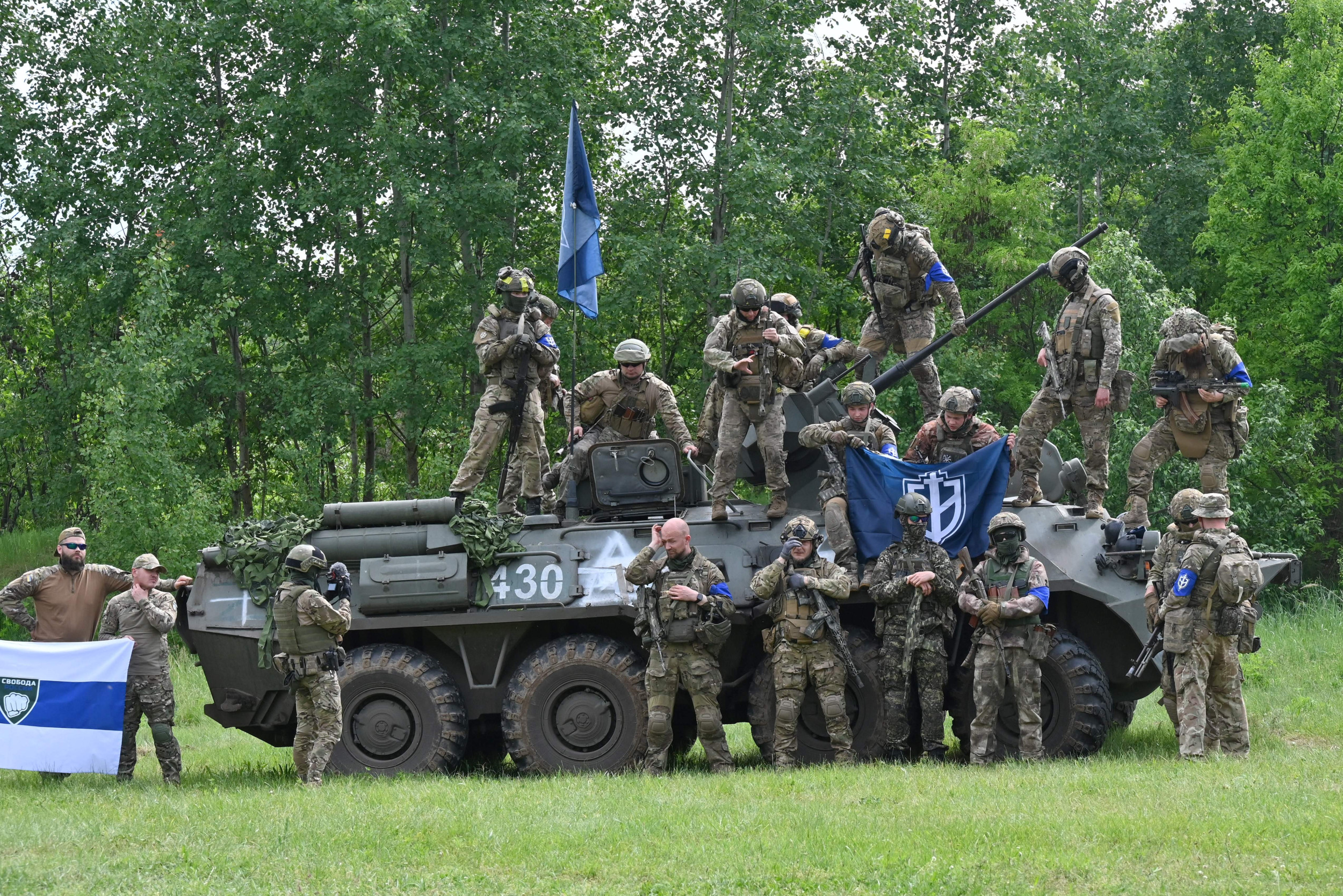
The Kremlin has blamed Ukrainian forces for raids in Belgorod, but Kyiv has denied responsibility. Two Russian anti-government groups—the Russian Volunteer Corps (RVC) and the Freedom of Russia Legion—have previously said they were behind attacks in the Belgorod region.

Ilya Ponomarev, an exiled Russian politician who says he is the political representative for the Freedom of Russia Legion, told Newsweek in June that the group, alongside the RVC, had crossed into the border town of Shebekino in Belgorod.

The Freedom of Russia Legion was formed weeks after Russia’s invasion of Ukraine began in February 2022, and is made up of defectors from the Russian armed forces and Russian and Belarusian volunteers. The RVC says its members include Russians fighting on Ukraine’s side and against the Kremlin regime.

Ukraine has maintained that Russian volunteer fighters are conducting the incursions into Belgorod, and British intelligence has called the RVC and the Freedom of Russia Legion “partisan groups.”

Putin said in June that Moscow was inadequately prepared to respond to attacks on border regions like Belgorod.

“Of course, there is nothing good in this,” Putin said at the time. “But in principle, one could have assumed that the enemy would behave this way, and one could have prepared better.”

Do you have a tip on a world news story that Newsweek should be covering? Do you have a question about the Russia-Ukraine war? Let us know via worldnews@newsweek.com.

Israel gives Putin a sharp lesson in military mobilization

0

Israel has said it successfully mobilized a record 300,000 army reservists in 48 hours—a feat that took Russia more than a month after Russian President Vladimir Putin announced a partial mobilization of the population for his war in Ukraine last fall.

The Israel Defense Forces (IDF) announced the mobilization drive in a televised statement after Hamas militants launched a surprise multi-front attack from the Gaza Strip into southern Israel over the weekend.

Chief military spokesperson Rear-Admiral Daniel Hagari said on Monday that 300,000 reservists have been called up by the military since Saturday. He added that Israel has “never drafted so many reservists on such a scale” and that “we are going on the offensive.” Newsweek has yet to substantiate this figure.

It represents 3 percent of Israel’s population, and is, according to the newspaper The Jerusalem Post, the country’s largest mobilization drive in history.

It’s the same amount of fighters Russian President Vladimir Putin said would be drafted to fight in Ukraine as part of his partial-mobilization order that he announced in the fall of 2022.

Russian Defense Minister Sergei Shoigu said on September 21 last year that Russia would be targeting 300,000 reservists and ex-military personnel with “certain military specialties and relevant experience.” The figure represents 0.2 percent of Russia’s population.

The Kremlin said the partial mobilization was completed on October 28, 2022, with tens of thousands already sent to the front lines in Ukraine by that date.

“The task set by you of [mobilizing] 300,000 people has been completed. No further measures are planned,” Shoigu said at the time, adding that, of the 300,000 mobilized reservists, 218,000 were undergoing training, and 82,000 had been deployed to Ukraine.

Putin’s partial-mobilization order was partly seen as unsuccessful due to the huge numbers of Russians who fled abroad to avoid being conscripted. Just days after the decree, more than 370,000 citizens fled the country since the decree—more than the total number that defense officials said would be called to enlist in the military.

Newsweek has contacted Russia’s Defense Ministry for comment via email.

Re: Russia, an analysis and policy network, found that the top nine recipient regions for Russian émigrés between February 2022 and July 2023 were Kazakhstan, Serbia, Armenia, Turkey, the European Union (EU), Israel, Montenegro, Georgia, and the United States, the Economist reported in August.

Russia took far longer to mobilize 300,000 people to its military than Israel, despite offering an attractive salary package to recruits.

All Russian combatants fighting in Ukraine are entitled to a lump sum from the Ministry of Defense of 195,000 rubles ($2,080) upon signing a contract of at least one year. Monthly salaries vary depending on military rank, position and length of service, but are no less than 204,000 rubles ($2,176). Combatants also receive regional payments from authorities, which vary nationwide, according to analysis by Not Moscow Speaks, which was created by a group of independent Russian journalists.

The independent investigative publication Agentstvo said that, in Israel, conscripted reservists aren’t offered such an attractive salary and are paid as much as they would be paid in their main job.

The news outlet added that conscripted Israeli soldiers became involved in hostilities immediately after being drafted, while, in Russia, the majority trained at military camps before being sent into the war zone.

Do you have a tip on a world news story that Newsweek should be covering? Do you have a question about the Russia-Ukraine war? Let us know via worldnews@newsweek.com.

Image shows Russian-erected Lenin statue in flames after explosion

0

A Russian-installed official in an occupied region of Ukraine blamed Kyiv’s military for a Monday attack on a statue of Vladimir Lenin, founder of the Russian Communist Party.

Volodymyr Leontiev, the Kremlin-approved head of the district council in the occupied city of Nova Kakhovka in the Kherson Oblast, told Russian-state media outlet TASS that a Ukrainian military drone was responsible for an attack that left the monument of the Soviet revolutionary in flames. Kyiv has not commented on the incident as of press time.

Kherson has been the site of heavy conflict throughout the war that Russian President Vladimir Putin launched against Ukraine in February 2022. During the early stages of the conflict, Putin’s forces seized control of much of the Kherson region. However, a successful counteroffensive later that year saw Kyiv reclaim significant portions of the oblast, including the city of Kherson in November.

Despite the armed forces of Ukraine liberating parts of the Kherson Oblast, Putin nonetheless illegitimately annexed the region and four other Ukrainian territories to Russia in September 2022. Kherson has since seen much fighting during the ongoing counteroffensive that Ukraine launched in the summer, while Nova Kakhovka—the site of a dam explosion in June that garnered much international attention—remains under Russia’s control.

Most, a local media outlet in the Kherson region, posted an image on its website of the attack on the Lenin statue in Nova Kakhovka’s town square. Ukraine’s coat of arms—a trident—also appears to have been drawn on the ground in front of the statue.

Several social media users later posted Most’s image on X, formerly Twitter.

“Yesterday [Monday], a significant amount of explosives was dropped—and today it was ‘advertised’ as a special achievement—next to a monument that was installed by our grandfathers, and some people’s great-grandfathers, here in front of the executive committee on the square,” Leontiev said, according to a post on the Telegram channel for TASS.

Leontiev added that figures in Ukraine have been sharing footage of the incident while bragging about the attack on the statue as a “special achievement.”

Newsweek reached out to the Ukrainian Ministry of Foreign Affairs via email for comment.

TASS reported that the Lenin statue received minor damage from the explosion, while windows in a nearby administration building were shattered by the blast.

Ukrainian news outlet Ukrainska Pravda said the Lenin statue had been installed by Russian authorities in April 2022 after the monument had previously been removed in 2014 by local officials.

Who is Natalie Raanan? Fears that Illinois teen taken hostage by Hamas

0

An Illinois teenager and her mother are feared to have been taken hostage by Hamas militants.

Natalie Raanan, 18, and her mother Judith Raanan, 59, of Evanston, arrived in Israel in early September to visit relatives and celebrate the High Holidays, their family told the Chicago Sun-Times.

Neither have been heard from since around midday on Saturday, they said.

Early that morning, Hamas fighters blew through Israel’s heavily fortified separation fence and crossed into the country from Gaza. Militants went on a rampage, gunning down people and taking others hostage. Israel formally declared war on Sunday.

Raanan and her mother were last in Nahal Oz, a kibbutz located less than two miles from Gaza, their family told the newspaper.

The Evanston Chabad posted a message on Facebook, asking followers to pray for the mother and daughter.

“Our broken hearts are with our brothers and sisters during this most painful and devastating time in Israel,” the post said.

“Please pray and do an extra mitzvah for all the wounded and captured, and for our dear Chabad of Evanston congregate Yehudit bat Tamar and her daughter Natalie bat Yehudit who have apparently been adbucted from Nachal Oz, Israel.”

In a statement to Newsweek, Rep. Jan Schakowsky, a Democrat from Illinois, said: “This weekend, my team and I received the horrifying news that two of my constituents, who were visiting Israel for the Jewish holidays, are missing, and are believed to have been abducted.”

Schakowsky said her office reached out to the State Department.

“Very quickly, we received a response letting us know that they are looking into the case,” she said. “I remain in close contact with the family and friends of my missing constituents and will continue to do all I can to ensure their safe and immediate return. We must all stand united and unequivocally condemn the vicious attacks carried out by Hamas.”

Who is Judith Raanan?

Judith Raanan has been a member of Chabad of Evanston for a decade.

“She’s an exceedingly warm, kind, giving, generous woman,” Rabbi Meir Hecht, the chabad’s co-director of community outreach, told the Sun-Times.

“She was always involved in helping people and being there to show support whenever someone needed a shoulder to lean on. She’s a really kind woman,” he said.

Newsweek has contacted Hecht for further comment via email.

Saturday’s surprise attack was the deadliest in Israel in decades. The death toll in Israel has risen to more than 900, The Associated Press reports, citing the Israeli military. In Gaza, more than 680 people have been killed, according to AP, citing authorities there.

President Joe Biden on Monday said 11 Americans were among the dead.

“It’s heart wrenching. These families have been torn apart by inexcusable hatred and violence,” he said in a statement. “We also know that American citizens still remain unaccounted for, and we are working with Israeli officials to obtain more information as to their whereabouts.”

Some families who have not heard from their missing loved ones do not know whether they have been killed, taken by Hamas or are on the run.

Biden said it is likely that U.S. citizens are among those being held hostage by Hamas.

“While we are still working to confirm, we believe it is likely that American citizens may be among those being held by Hamas,” he said. “I have directed my team to work with their Israeli counterparts on every aspect of the hostage crisis, including sharing intelligence and deploying experts from across the United States government to consult with and advise Israeli counterparts on hostage recovery efforts.”

State Department spokesperson Matthew Miller told Newsweek on Monday that authorities are working to locate Americans.

“We can confirm that there are unaccounted-for U.S. citizens, and we are working with our Israeli partners to determine their whereabouts,” Miller said.

Neither U.S. nor Israeli authorities have provided details about how many Americans may be being held hostage by Hamas.

But as Israel retaliates with air strikes, Hamas has warned it will kill one of the more than 100 hostages it says it has captured every time Israel’s military bombs civilian targets in Gaza without warning.

Hamas spokesman Abdel-Latif al-Qanoua told The Associated Press that the group’s fighters had captured Israelis as recently as Monday morning.

He said the group wants all Palestinian prisoners held by Israel to be freed. In the past Israel has agreed to exchange deals in which it released large numbers of prisoners for individual captives or even the remains of soldiers.

Update 10/11/23, 7:50 a.m. ET: This article has been updated to add comment from Rep. Jan Schakowsky.

Texas judge rebels against death penalty ruling in extraordinary move

0

A federal appeals court on Monday upheld a ruling delaying the scheduled execution of a Texas inmate, but one dissenting judge rebelled against the ruling by publishing a fake majority opinion.

Jedidiah Murphy, 48, had been set to receive a lethal injection at the state penitentiary in Huntsville on Tuesday evening. He was condemned for the 2000 fatal shooting of 80-year-old Bertie Lee Cunningham during a carjacking in Garland, a suburb of Dallas.

Last week, a federal judge in Austin issued an order staying Murphy’s execution after the inmate’s lawyers filed a lawsuit seeking DNA testing of evidence related to his 2001 trial.

The 5th U.S. Circuit Court of Appeals upheld that order in a 2-1 vote on Monday.

In the ruling, the three-judge panel noted that there was a pending case before the court brought by a different Texas death row inmate that raises similar issues.

“We agree with the district court that a stay is appropriate at least until a decision in that case,” Judge Leslie Southwick wrote for the court’s majority.

However, Judge Jerry E. Smith, the sole vote against allowing the stay to remain in place, then published what he called “the Fifth Circuit panel opinion that should have been issued” as an attachment to his dissent.

The majority opinion is “grave error,” Smith wrote in his dissent. “It succumbs to a vapid last-minute attempt to stay an execution that should have occurred decades ago.

“In the interest of time, instead of penning a long dissent pointing to the panel majority’s and district court’s myriad mistakes, I attach the Fifth Circuit panel opinion that should have been issued.”

Smith concluded the opinion that the court did not actually make by writing that the district court had “abused its discretion in granting Murphy’s September motion to stay execution. Accordingly, we VACATE the stay of execution.”

“I suspect that he thought he was writing the majority opinion and was surprised when neither of the other two judges on the panel voted to lift the stay,” Robert Dunham, the director of the Death Penalty Policy Project and an adjunct professor at the Temple University Beasley School of Law, told Newsweek.

“I would take Judge Smith at his word when he said that he was attaching that opinion ‘in the interest of time,’ and would let others judge whether publishing an opinion that invokes an alternate reality is appropriate or inappropriate judicial conduct.

“However, I would say that the vitriolic language in Judge Smith’s dissent and in his non-majority alternate opinion reflects the increasingly transparent extremism of segments of the federal bench and the Fifth Circuit in particular.”

Journalist Chris Geidner criticized Smith’s behavior, noting in his Law Dork newsletter that there’s nothing within the attachment suggesting that the opinion is fake and not law.

“Instead, Smith put out into the world what amounts to little more than his fan-fic majority opinion,” Geidner wrote. “This is not appropriate judicial behavior, and it’s honestly very confusing. There’s now a document out there, formatted like an opinion of the Fifth Circuit, that is undoubtedly going to be incorrectly cited to and quoted from in the future.”

Geidner added that Smith including the names of the other judges in the attachment is “arguably unprofessional.”

What’s worse, he wrote, is that it occurred in a death penalty case. “Smith inserting unnecessary confusion into the already tense, complex process surrounding executions is truly abhorrent behavior,” Geidner wrote.

The Texas Attorney General’s Office had sought to overturn the stay order. Newsweek has contacted the office for comment.

According to The Associated Press, Murphy’s attorneys have argued that evidence of two robberies and a kidnapping used by prosecutors to convince jurors who had already convicted Murphy of capital murder that he would be a future danger—a finding needed to impose a death sentence—was riddled with issues.

Murphy has admitted his guilt in Cunningham’s death, and expressed remorse, but has denied he committed the other crimes. His attorneys believe DNA testing would help show he did not commit the robberies and kidnapping.

Texas prosecutors oppose the DNA testing, arguing that state law only allows for post-conviction testing of evidence related to guilt or innocence and not to a defendant’s sentence.

If Murphy’s execution went ahead on Tuesday, he would have been the sixth inmate put to death in Texas this year. It would have coincided with World Day Against the Death Penalty, an annual day of advocacy by death penalty opponents.

Death penalty opponents have been advocating for Murphy, citing a long history of mental illness and abuse he suffered as a child while he was in and out of foster care.

Murphy’s case “highlights how easy it is for troubled and mentally ill youth to fall through the cracks of our foster care system,” Abe Bonowitz, the executive director of Death Penalty Action said in a statement provided to Newsweek.

“The common thread among most prisoners facing execution in the United States is the abuse, neglect and addiction they have suffered in their youth. We hope this can be another wake-up call to policy makers that we must improve the social safety nets that could have prevented this murder from happening in the first place.”

Update 10/10/23, 10:10 a.m. ET: This article has been updated to add comment from Robert Dunham.