Friday, May 8, 2026
Home Blog Page 54

In Visit to the Border, RFK Jr. Models a Leader Who Listens and Learns

0

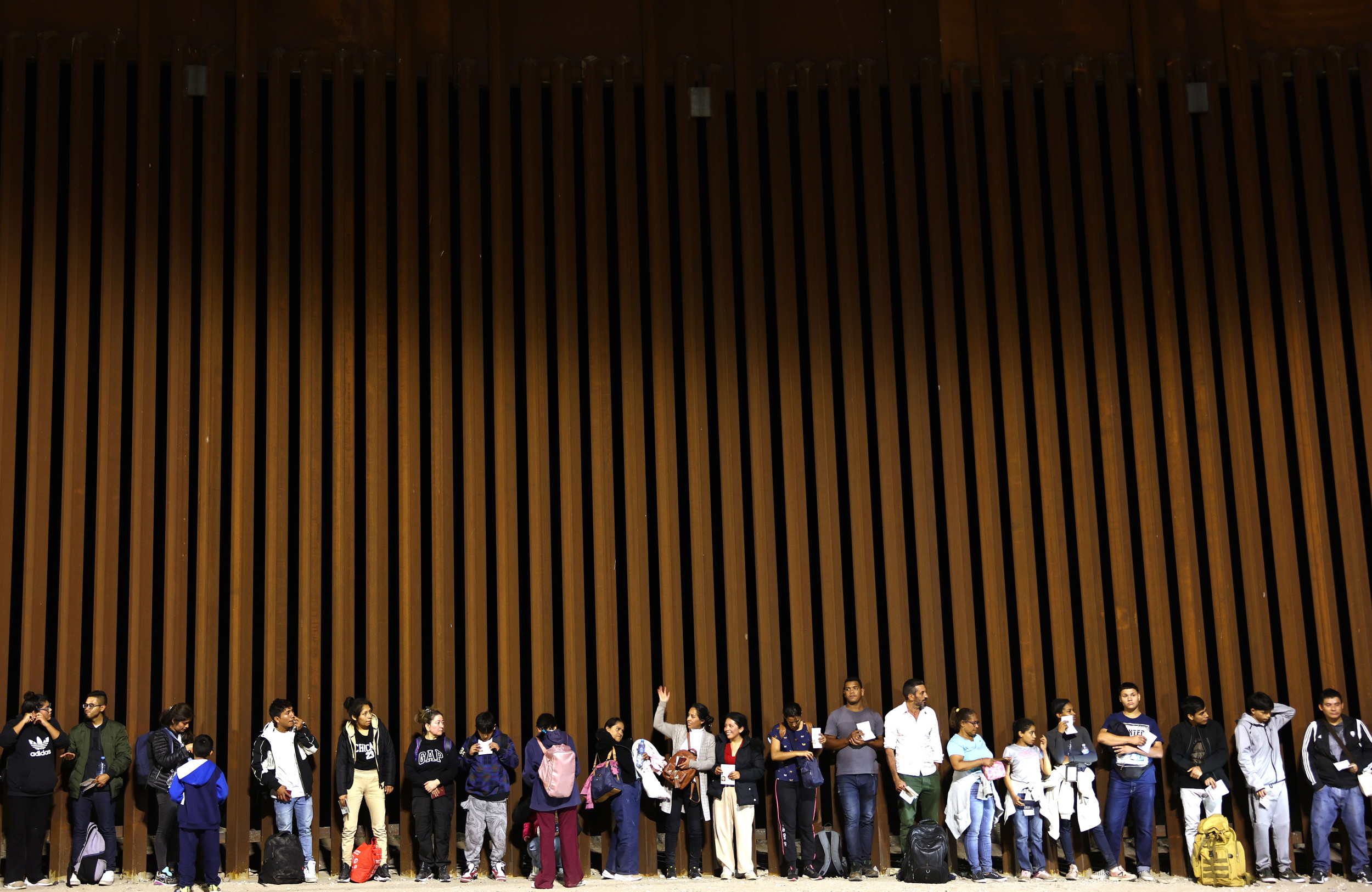
When Democratic presidential candidate Robert F. Kennedy, Jr. came to my hometown of Yuma, Arizona, in early June, he said it took him about three days to really understand and process what he was seeing. He expected that the vast majority of migrants streaming across the border would be from Central America; instead, he discovered an uncontrolled flow of desperate people from all around the globe—including China, Russia, Ukraine, Iraq, Cancun, Azerbaijan, Bangla Desh, Ukraine, and a variety of African nations.

I told him that the human trafficking operation run by the Mexican drug cartels has become so profitable that there had recently been more than 300 assassinations just 25 miles on the other side of the border in the fight for control of the booming trafficking business. Kennedy said that after coming to Yuma to get a grasp of the chaotic situation at the border, he came “to understand that the open border policy is just a way of funding a multi-billion dollar drug and human trafficking operation for the Mexican drug cartels.”

He also saw the devastating impact of the open border policy on the local community. Hospitals and social services are flooded with migrant-related emergencies that they have no capacity to serve local residents. Parents who no longer feel comfortable allowing their children to play outside because of fear of violence or kidnapping as local law enforcement is focused on the tsunami of indigent migrants. The continuing degradation of civil society with increases in crime, disorder, and homelessness, as well as an influx of the deadly fentanyl and methamphetamine from which the cartels profit, is apparent everywhere.

Whatever the intentions of the Biden administration’s “No More Wall” Executive Order to reverse the immigration policies of the Trump administration, the results have been catastrophic, and not just for border communities like Yuma. They’ve been so catastrophic, in fact, that the president has recently been forced to concede that he has “no choice” but to build 20 miles more of Trump’s border wall, after having pledged not to build another foot during his 2020 campaign. This, after quietly auctioning off 300 million dollars’ worth of unused material for wall construction for peanuts, unused parts left to rust when Trump left office.

The destabilizing effects of these thoughtless policies are roiling cities across the U.S. as they struggle to provide the waves of newly arrived migrants with housing, medical care, and social services. In New York City, Mayor Eric Adams recently warned that the migrant crisis could “destroy” the city if it doesn’t get more help to cope with an influx of migrants. The migrant situation in his city has become so acute (with more than 110,000 arriving since spring 2022) that last week Adams made a desperate trip through three Latin American nations to convince aspiring immigrants not to come. “There is no more room in New York,” stated the mayor. “Our hearts are endless, but our resources are not.” In some sense, every American city has become a border town.

Still, border communities face their own unique crises. The misbegotten Executive Order that President Biden signed immediately after coming into office directly led to the utterly chaotic situation we now find in Yuma and countless other border towns. By depriving our border agents of the necessary means to enforce the law, we have essentially transferred control of our immigration policy to the drug cartels, resulting in a flood of desperate, exploited migrants and a humanitarian disaster of epic proportions.

Of course, the biggest victims of this strategy (or lack of strategy) are the migrants themselves. Human trafficking, mass rape, and unprecedented numbers of separated and unaccompanied children are the legacy of this mindless, reactionary policy. A nation without effective borders with no capacity to monitor who is coming in, is not a nation at all.

It is not “compassionate” to refuse to have an orderly, functioning immigration policy; it is suicidal. The current situation, with an estimated 1.5 to 2.2 million migrants pouring unrestricted over our southern border each and every year, should be of grave concern to every American.

After seeing the situation with his own eyes, Kennedy is advocating a new approach, motivated by compassion, not bigotry, or xenophobia. First, he proposes regaining control over the border with the technology, physical barriers, and trained personnel that were dismantled and defunded by the current administration. Border communities like Yuma understand that this is perfectly doable with adequate funding, and we have done it in the past.

Second, he proposes fixing the dysfunctional asylum system. With millions of backlogged cases, political asylum claimants currently just walk across the border and then are processed and bused into communities all over the U.S. before any hearing to determine the validity of their claim (if a hearing ever takes place). If claimants to political asylum understood that their case would be determined swiftly at the border before being granted entry into the country, most would not undertake the considerable dangers and expense of entrusting themselves to cartels to get them across the border.

Finally, Kennedy proposes working with the Mexican government to stem the flow of transit migration through Mexico. The Mexican government has every incentive to cooperate in restoring order to the situation since the impact of handing over immigration policy to the drug cartels has been devastating to public safety on their side of the border, as well as ours.

Upending the business model of the drug cartels seems like a great strategy for getting the situation under control. And the compassionate, humanitarian approach Kennedy proposes has the potential to win support from both sides of the political divide. It just goes to show what comes of approaching a problem with an open mind and a desire to understand and help people as opposed to the usual partisan, special interest-motivated grandstanding.

I hope other political leaders start to approach policy with RFK, Jr.’s attitude.

Jonathan Lines is Yuma County Supervisor District 2.

The views expressed in this article are the writer’s own.

Gas prices in U.S. may spike after Israel attacks

0

Oil prices jumped on the back of fighting in the Middle East between Israel and Hamas, a reaction that could have implications for the cost of gas at the pump.

West Texas Intermediate, which tracks oil that comes from American sources, was up more than 4 percent as of 11:02 a.m ET from Friday, according to Bloomberg data. Brent crude, a benchmark for global oil prices, jumped nearly 4 percent.

A surprise Hamas attack on Saturday killed more than 700 people in Israel, according to the Associated Press. Strikes against Gaza that followed the unprecedented incursion killed nearly 500 people in the Gaza Strip, still according to AP.

Part of the reason that oil prices have spiked may be due to fears that the conflict between Israel and Hamas could broaden to include Iran. The Wall Street Journal reported on Sunday that Iranian officials had helped Hamas plan the attack on Israel. But Secretary of State Antony Blinken said on Sunday that there was no direct evidence that Tehran was involved in the attack.

“In this moment, we don’t have anything that shows us that Iran was directly involved in this attack, in planning it or in carrying it out, but that’s something we’re looking at very carefully,” Blinken told NBC‘s Meet the Press on Sunday.

Some analysts said on Monday that if Iran is sucked into the conflict, and is hit with new sanctions that curtail even further its oil exports, prices could hike, hitting the cost of gas as a result.

Americans have been struggling with a high cost of living, principally due to high inflation. A jump in oil prices and its subsequent impact on the cost of gas would squeeze their pocketbooks further.

“In terms of Iran’s involvement, it only complicates this, given the fact that their oil output is up about 55 percent since the lows of 2020,” Kristen Bitterly Michell, head of Citi Global Wealth Investments for North America, told Bloomberg. “The key to understanding whether this would have broader implications, it’s clearly the scope of the regional conflict and then the pressures it would put in areas like the oil market.”

An expanded conflict involving Iran could also affect supply of oil as well, according to experts.

“If the conflict envelops Iran…up to 3 percent of global oil supply is at risk. And if a wider conflict eventuates that ends up impacting transit through the Strait of Hormuz, around 20 percent of global oil supply could be held hostage,” energy analyst Saul Kavonic told Reuters.

The Strait of Hormuz, which separates Iran, to the north, from the Arabic Peninsula, to the south, has often been the scene of tensions. In July, the U.S. Navy said Iran had attempted to seize two oil tankers sailing through the strait.

Newsweek reached out to the U.S. Department of Energy for comment via email.

Influential GOP activist condemned for meeting with white nationalist

0

The leader of an influential conservative political action committee in Texas is being denounced for reportedly meeting with white nationalist Nick Fuentes.

Last year, former President Donald Trump came under fire for dining with Fuentes and rapper Kanye West, who has also been accused of antisemitism. West said that Trump was “really impressed” by Fuentes during the encounter, although the former president later insisted that he “didn’t know” the white nationalist.

Fuentes said in a video in August that he had decided to “forget the Constitution” and instead “swear allegiance to Donald Trump.”

Jonathan Stickland, a former Republican state lawmaker who serves as president of the Defend Texas Liberty PAC, hosted a meeting over the weekend with Fuentes at the headquarters of a Forth Worth consultancy firm that he owns, according to the Texas Tribune.

Fuentes, who has advocated for “a homeland” for white people and denies the reality of the Holocaust, was reportedly photographed on Sunday morning entering the headquarters of Strickland’s Pale Horse Strategies and remained inside the building for more than six hours.

Kyle Rittenhouse, a favorite in far-right circles since he was acquitted of homicide charges after fatally shooting two Black Lives Matter protesters in 2020, also reportedly attended the meeting.

Republican Texas House Speaker Dade Phelan on Monday referenced the ongoing and volatile Israeli-Palestinian conflict while condemning Strickland’s meeting with Fuentes.

“Jonathan Stickland, the President of Defend Texas Liberty PAC, fraternized for six hours with a notorious, anti-Semitic, nazi sympathizer who denies the existence of the Holocaust,” Phelan said in a statement shared on X, formerly Twitter.

“This [is] not just a casual misstep,” he added. “It’s indicative of the moral, political rot that has been festering in a certain segment of our party for far too long. Anti-Semitism, bigotry and Hitler apologists should find no sanctuary in the Republican party. Period.”

Newsweek reached out for comment to Defend Texas Liberty PAC over the phone on Monday.

Rittenhouse referred to Strickland as the “most conservative boss out there” while commenting on Strickland posting a photo of the two of them together to X in August.

Phelan’s statement on Monday went on to demand that GOP politicians who had taken money from Defend Texas Liberty PAC return their donations due to the association with Fuentes.

“There is no excuse to keep tainted funds from an organization that provides a platform for hatemongers, sexual predators, racists and nazi sympathizers,” said Phelan.

Phelan specifically condemned Texas Lieutenant Governor Dan Patrick for taking “$3 million from this organization” and the Texas Republican Party for receiving “$132,500 during this election cycle.”

Texas Republican Party Chair Matt Rinaldi was spotted entering and exiting Pale Horse Strategies during the time of Stickland’s purported meeting with Fuentes and Rittenhouse.

However, Rinaldi insisted that he was “just borrowing a conference room” in comments to the Texas Tribune. Rinaldi added: “I completely condemn [Fuentes] and everything he stands for. I would never in a million years meet with that guy.”

Patrick responded to Phelan’s statement by issuing a statement of his own a short time later, condemning Fuentes while accusing the state House speaker of engaging in a “political stunt” and calling for his resignation.

“I didn’t think even Dade Phelan would stoop this low. He has now absolutely hit rock bottom,” Patrick said. “Nick Fuentes and his antisemitic rhetoric have no place in the United States.”

“I am calling on Dade Phelan to resign his position before the House gavels in this afternoon,” he continued. “There is no place in Texas political discourse for any elected official to use the atrocities in Israel for their own political gain.”

Joe Biden blasted for "hosting barbecue" while Israel attacked

0

A number of right-wing figures have criticized President Joe Biden for hosting a barbecue at the White House at the weekend amid the heavy fighting between Israeli forces and Hamas militants.

Republican Missouri Senator Josh Hawley was one of those to condemn Biden for holding the event for White House staff and their families on Sunday, which including a live band, one day after Hamas launched it surprise incursion in what became the deadliest day of fighting in the Israel-Palestine conflict for decades.

At least 700 people have been killed in Israel, and a further 400 in Gaza, since the incursion by Hamas according to the Associated Press. Israel has officially declared war against the Islamist organization, which has been designated as a terrorist group by the U.S. and the European Union.

Hamas is alleged to have captured Israeli hostages, including elderly people and children. Israel and U.S. Secretary of State Antony Blinken also reported that American citizens may have been taken hostage. The reports haven’t yet been confirmed.

“While Hamas holds Americans hostage, Joe Biden is enjoying a picnic with a live band,” Hawley posted on X, formerly Twitter, while sharing a White House pool report noting that music “could be heard coming from the area around the Rose Garden” on Sunday evening. The pool report added that Biden and the First Lady were “hosting a BBQ” for White House executive resident staff and their families.

Scott Taylor, a former Virginia Republican congressman, added: “Given recent events, and certainly with the news of many Americans being held hostage in Gaza, I think I would have canceled the White House BBQ with the live band.”

“This weekend, several Americans were killed in Israel and several more are still being held hostage by Hamas. Today, Joe Biden called a lid at 11:34 a.m. and is having a barbecue,” political commentator and podcast host Benny Johnson posted. The term ‘calling a lid’ is used by political reporters to mean that the president will not be making any more public statements or be available to the press for the rest of the day.

C.J. Pearson, a conservative activist and commentator, added: “There are American hostages being held captive by Hamas and Joe Biden is currently having a barbecue at the White House. The case for impeachment couldn’t be more strong.”

Reacting to the criticism, a White House official told Newsweek: “President Biden has been consistently engaged in supporting Israel as they defend themselves against these brutal terrorist attacks.

“Yesterday, after another call with Prime Minister Netanyahu and ordering the American military to provide aid to the IDF to ensure they have what they need, the President held a long-scheduled event to thank the hardworking non-political staff who keep the White House running—operating the kitchens, cleaning the White House, and helping keep the complex safe.

“This date was chosen because there were not White House activities that would require their work and they could bring their families. They deserve recognition, and no small, petty comments from partisan media or elected officials change that.”

On Sunday morning, Biden spoke to Israeli Prime Minister Benjamin Netanyahu. The president expressed his “deep sympathy” for all those missing, wounded and killed during the “unprecedented and appalling assault by Hamas terrorists.”

“They discussed the taking of hostages by Hamas terrorists, including entire families, the elderly, and young children,” the White House said in a readout detailing the conversation.

“The President emphasized that there is no justification whatsoever for terrorism, and all countries must stand united in the face of such brutal atrocities.”

Biden also confirmed that the U.S. will be sending “additional assistance” to the Israeli Defense Forces as it battles with Hamas.

Update 10/9/23 at 12:15 p.m. ET; This article was updated with comment from a White House official.

Shani Louk video captures final moments at festival before Hamas attack

0

A video showing a woman dancing at a music festival near the Gaza-Israel border before she was taken by Hamas militants has gone viral on social media.

The outdoor Tribe of Nova festival was among the first targets of Hamas fighters as they launched an unprecedented attack in the early hours of Saturday morning.

Graphic footage circulated on social media showed a nearly naked woman lying face-down in the bed of a pick-up truck with four militants, apparently being paraded through the streets.

Family members identified her as Shani Louk, a 22-year-old German-Israeli. She appeared to be dead in the video, but her family are holding out hope that she is alive.

On social media, a video apparently taken from Louk’s Instagram account appeared to show her and other revelers dancing at the festival before the attack.

“These are probably the last moments of her before Hamas attacked music festival,” one person posted on X, formerly Twitter, alongside the clip, with the video already viewed more than 66,000 times.

Louk’s mother, Ricarda Louk, has pleaded for information about her daughter in a video shared on social media.

“We were sent a video in which I could clearly see our daughter unconscious in the car with the Palestinians and them driving around the Gaza Strip,” she said, according to a translation of her remarks.

“I ask you to send us any help or any news. Thank you very much.”

Louk’s cousin, Tomasina Weintraub Louk, told The Washington Post that family members had desperately tried to contact Louk, as well as her Mexican boyfriend, but couldn’t get through.

“We knew she was in the party; she didn’t answer,” she told the newspaper.

Although the woman in the video is lying face-down, she said they recognized her by her tattoos and dreadlocks.

She added that the family have “some kind of hope” that she is alive.

Louk’s aunt, Orly Louk, told the German newspaper Der Spiegel that her niece had grown up in Israel, but was a globetrotter who never stayed in one place for too long.

She was a pacifist, her aunt said, and refused to take up the military service that is mandatory for Israelis. Her German passport had helped her, she added.

She said the last photo her niece posted on social media was a mirror selfie before heading to the festival. The image shows her looking to the side, wearing dark eye makeup and a scarf covering her long dreadlocks. “She often posted selfies on Instagram,” her aunt said.

Other video footage from the attack on the music festival showed a young woman being abducted by men on a motorbike as she cried for help, while another man was led away with his hands behind his back.

Paramedics removed about 260 bodies from the festival site, according to the Israeli rescue service Zaka.

Hamas is holding more than 100 people captive, Hamas official Mousa Abu Marzouk told Arabic language news outlet al-Ghad on Sunday. That is in addition to more than 30 people said to be held by the Palestinian Islamic Jihad militant group.

Festival organizers said in a statement on Facebook that they were assisting security forces to help locate missing people who attended the event.

“We strengthen and share the grief of the missing and murdered families,” the statement said.

“We are doing everything we can to assist the security forces, stand with them in constant contact and are located in the area in scans and searches in order to locate the missing.”

The statement said they “pass on to relevant parties every piece of information that comes to us about additional missing persons.”

Trump blasts Biden on Hamas, claims "same people" are crossing U.S. border

0

Donald Trump has baselessly suggested that Hamas is plotting to attack inside the U.S. because of the immigration policies of President Joe Biden and former President Barack Obama.

On Saturday morning, Hamas initiated a large-scale surprise attack on Israel, launching a barrage of missiles from the Gaza Strip and sending fighters into Israeli territory. The Israeli military has hit the Hamas-ruled territory with a series of airstrikes, and over 1,100 people had been killed on both sides as of Monday morning, according to the Associated Press. Thousands more were reported injured.

Trump said in a Truth Social post on Monday that U.S. taxpayers “helped fund” the Hamas attack, possibly because Biden approved $235 million in aid to Palestinians in 2021. However, there is no evidence that any of the funds went to Hamas. The bulk of the aid went to fund humanitarian assistance administered by the United Nations.

The former president ramped up his rhetoric against Biden a short time later, saying without evidence that the president’s immigration policies had resulted in Hamas militants “pouring” across the U.S.-Mexico border. Trump also said that Biden and his “boss,” Obama, would be responsible for any Hamas attacks inside the U.S.

“The same people that raided Israel are pouring into our once beautiful USA, through our TOTALLY OPEN SOUTHERN BORDER, at Record Numbers,” Trump wrote on Truth Social. “Are they planning an attack within our Country? Crooked Joe Biden and his BOSS, Barack Hussein Obama, did this to us!”

Newsweek reached out for comment to the White House via email on Monday morning.

There is no evidence to back up the claim that militants from Hamas, which the U.S. government considers a terrorist group, are flooding across the U.S.-Mexico border. U.S. Customs and Border Protection (CPB) statistics show that 76 people on the U.S. terrorist watch list have attempted to cross the southern border during 2023 so far.

The CBP statistics do not indicate that any of those trying to cross were Hamas militants. There is no evidence that the group, which has sworn to destroy Israel and establish an Islamic state, intends to attack inside the U.S. or anywhere else outside of the Middle East.

In addition, border encounters with migrants on the terrorist watch list appear to have been significantly higher during the Trump administration than under Biden. Sixty-seven encounters were recorded under Biden in 2022, while 155 were recorded at the same point during Trump’s presidency, in 2018.

While Trump appears to be blaming Biden for the current Israeli-Palestinian conflict, others have pointed their fingers at the former president.

On social, media, some have suggested, without evidence, that Trump’s alleged sharing of classified intelligence with Russian officials during his presidency resulted in sensitive information from Israel being passed on to Iran, a Hamas ally. This brought speculation that the weekend’s attack on Israel was facilitated by the information sharing with the militant group.

14,300-year-old tree reveals apocalyptic warning for today’s humans

0

Evidence of the most powerful solar storm in history has been uncovered in an unlikely place: within the rings of a tree.

This immensely powerful solar storm is thought to have been at least 10 times as powerful as the Carrington Event of 1859, which caused chaos in the rudimentary telegraph system of the time.

New research has now found that a radiocarbon spike found within ancient tree rings in the French Alps reveals the full extent of the sun’s power and the potential danger it poses to us if a storm of this scale occurs today, according to a study published in the journal Philosophical Transactions of the Royal Society A Mathematical Physical and Engineering Sciences.

The researchers found a strange spike in radiocarbon within the rings of subfossilized trees dating to around 14,300 years ago.

“Radiocarbon is constantly being produced in the upper atmosphere by a chain of reactions initiated by cosmic rays (showers of high energetic particles coming from outside the solar system),” Tim Heaton, professor of applied statistics at the University of Leeds in England and co-author of the paper, told Newsweek. “Generally, the sun (and the Earth’s magnetic field) help shield us from the constant bombardment of these galactic cosmic rays—so that normally when the sun is more active, we get less radiocarbon being produced.

“However, in 2012, Fusa Miyake discovered a sudden and unexpected spike in radiocarbon levels in a Japanese tree from 774 AD. Initially, this was thought to have been caused by a supernova, but after more study, it was instead identified as being due to a huge solar storm on the sun,” Heaton said.

“Such extreme storms would throw out huge volumes of highly energetic particles from the sun. These energetic solar particles would have entered our atmosphere, leading to a sudden spike in radiocarbon production. Our storm is another Miyake event—but the largest that has ever been identified.”

The radiocarbon spike in the tree rings was found to line up with patterns in beryllium levels in Greenland ice cores, indicating that the spike was caused by a huge solar storm.

“We checked our 14,300-year-old radiocarbon spike by comparing it with beryllium-10 found in Greenland ice cores,” Heaton said. “Beryllium-10 is another chemical isotope that is produced in a very similar way to radiocarbon (in the upper atmosphere by the same energetic particles).

“The fact that the 14,300-year event was supported by both the radiocarbon and the beryllium-10 indicated that the massive production spike we found was genuine (and not noise). It also supported the solar origin of the event— i.e., a massive solar storm considerably bigger than any previously identified.”

Solar storms like this one and the Carrington Event are caused by solar flares, which are ejections of powerful X-rays from the sun.

“In general, a flare is a substantial release of energy from the sun and specifically an active region or sun spot,” Daniel Brown, an associate professor in astronomy and science communication at England’s Nottingham Trent University, previously told Newsweek.

“These are caused by magnetic field lines becoming more and more twisted storing energy like a rubber band, and at some stage, they snap and rearrange. That results in a massive release of electromagnetic radiation and also material from this region.”

The Carrington Event, thought to be the most powerful solar storm in modern history, caused widespread impacts to infrastructure in 1859, and led to an incredibly bright aurora in the night sky.

“In that strongest ever Carrington Event there were reports of telegraph lines sparking with the voltages induced in them,” Alan Woodward, a professor of computer science and space weather expert at England’s University of Surrey, previously told Newsweek.

A solar storm similar to the Carrington Event could lead to trillions of dollars worth of damages.

The solar storm measured in the tree rings is thought to be at least 10 times stronger than the Carrington Event, making it one of a class of extreme solar storms known as Miyake Events. Nine of these events have been identified as occurring in the last 15,000 years—the most recent of which occurred in 774 AD and 993 AD—but this new discovery may be the most powerful ever found.

“The Carrington Event is not identifiable by looking at past radiocarbon in trees—it did not leave a significant trace/spike in the radiocarbon record,” Heaton said. “It is thought that the Miyake events/storms are an order of magnitude bigger than the Carrington Event. Our 14,300-year-old storm is the biggest of all the Miyake event discovered so far (twice the size of the eponymous 774 and 993 AD storms first found by Fusa Miyake) so, at a guess, at least 10 times larger than the Carrington Event.”

This find therefore shows just how powerful the sun is capable of being and the possibility that a powerful solar storm like that could once again hit the Earth in the future.

“If similar solar storms happened today, they could be catastrophic for society as we are so reliant upon technology. In the worst-case scenario it has been estimated that the impact of such an extreme solar storm could cost us billions, or even trillions, of dollars in lost GDP,” Heaton said. “However, again, it is somewhat hard to know for sure as modern society has never directly experienced such storms and we don’t really know how resilient our current technology is.”

We need more research in this area to find out,” Heaton said. “Such an extreme storm could cause phenomenal damage to our electricity grids by creating geomagnetic disturbances (potentially destroying transformers and causing nationwide blackouts that last months). Additionally, the huge burst of energetic particles would rapidly hit our satellites in orbit, potentially destroying their solar panels and putting them permanently out of action. They would also generate a lot of radiation for astronauts which would be a big risk for their health.

“However, we don’t really know how resilient our current technology is to such huge events. This is the really big question—will our communication, electricity grids, and satellites mostly be able to withstand the impacts of such a storm and just suffer temporary effects before quickly coming back online? Or will they catastrophically fail?

“We really need more research to understand how resilient our existing technology is to such solar events and how we can best shield it from potential damage,” he said.

This new discovery does provide a new and exciting way to study the effects of past solar storms, which will help researchers get a sense of how common powerful events are.

“The really interesting thing is that currently we just don’t understand these massive Miyake storms: why they occur, how frequently, and if we can predict them. We urgently need more research to both better model the behavior of the Sun and improve our understanding of the risks it poses to Earth,” Heaton said.

“To date, we have now found 9 Miyake Events in the last 15,000 years (our storm is the largest found so far) so they are pretty rare. But the risks such an event might pose still mean it is critical to better understand their behavior so we can potentially mitigate their effects.”

Do you have a tip on a science story that Newsweek should be covering? Do you have a question about solar storms? Let us know via science@newsweek.com.

Update 10/09/23, 9:52 a.m. ET: This article was updated with comment from Tim Heaton.

Housing market warning over looming price corrections

0

Meredith Whitney, a financial analyst who was once called “the Oracle of Wall Street” for predicting the financial crisis of 2008, warned that generational shift in the U.S. will lead to a significant house price correction within the country’s housing market.

In a recent interview with Insider, Whitney—who in 2009 left brokerage and investment bank Oppenheimer (OPY) and founded her own research firm Meredith Whitney Advisory—said that house prices are destined to fall as the balance between supply and demand changes in the future.

“It’s just a matter of time,” Whitney said, predicting home prices will definitely drop from their recent highs. “Again, it’s not something that happens in one fell swoop, but it’ll be interesting to see the repercussions of that,” she added.

Historically low house supplies in the U.S. have contributed to bringing prices to skyrocketing heights since the beginning of the pandemic, when demand surged and mortgage rates were relatively low.

The crisis of affordability which followed the peak reached by house prices in June 2022 and a rise in mortgage rates temporarily slowed down demand until the end of this summer, allowing prices to slightly tumble and create the conditions for what experts called a housing market “correction.”

But with persisting low inventory, house prices have not dropped significantly and have even started picking back up in many areas across the country since late August. As of August 31, the latest data available on Zillow, the average value of a U.S. home was $349,770. This is 0.4 percent up on the average one year ago.

This stalling situation between demand and supply will change in the coming year, Whitney said, as Baby Boomers—the generation born between 1955 and 1964 and which represents a big portion of homeowners in the U.S.—put their homes on the market in an effort to downsize and save money. According to the U.S. Census 2021 data, the latest available, only 10 percent of American homeowners were under the age of 35.

This will flood the market with a number of available homes which buyers haven’t seen in over a decade in the U.S., where prices have grown by 42 percent since March 2020 alone. In turn, house prices will drop significantly, finally offering aspiring homebuyers a solid chance to buy a property.

“I’m always data-driven, so it’s just the math,” Whitney told the newspaper. “If you look at the percentage of homeowners that are 50 and up, that’s a staggering amount. And if you look at it historically, 50 percent of those over 50 typically sell and downsize, and that’s expense-driven.”

She added: “Even if you discount that down to a very conservative number, it’s just—from a mathematics standpoint—it puts a lot of housing inventory on the market.”

Whitney hasn’t specified by how much she expects house prices to decline by the end of the decade, but said that they will weaken more significantly in states like Pennsylvania, Connecticut, New Jersey and Illinois. She added that this correction won’t lead to a crash of the market.

Newsweek contacted Whitney for comment by email on Monday.

Putin faces Ukraine war headache after Israel attack

0

Russian President Vladimir Putin could stare down renewed Western support for Ukraine in the wake of days of bloodshed in Israel and Gaza, one expert has told Newsweek, as the death toll following the weekend’s violence rises.

“The recent escalation in the Middle East will only encourage Western countries for a more radical approach when it comes to supporting their allies,” Oleksandr Kraiev, an expert on U.S. foreign policy with the Ukrainian think tank Prism, told Newsweek.

“It is not about ‘less weapons, more peace.’ It is about providing tools for safeguarding peace,” Kraiev said. “So Israel may play into Ukrainian hands.”

Shortly after Palestinian militants fighting for Hamas launched coordinated land, sea, and air attacks on Israel early on Saturday and Israel started waves of air strikes on Gaza, the United States threw its weight behind Israel.

U.S. President Joe Biden said Washington would “offer all appropriate means of support” to Israel after the “horrific and ongoing attacks,” adding that the U.S. “unequivocally condemned this appalling assault against Israel by Hamas terrorists from Gaza.”

British Prime Minister Rishi Sunak said the United Kingdom was “unequivocally” supporting Israel. London is “poised” to support Israel militarily should it request such assistance.

Unveiling a new military aid package in mid-September, Biden said U.S. support for Ukraine was focused on Kyiv’s “long-term security” and making sure that Ukraine is “capable of deterring future threats against sovereignty, territorial integrity and freedom.”

“Because that’s what this is all about—the future, the future of freedom,” Biden said. “America can never, will never walk away from that.”

Kyiv is heavily reliant on Western aid, notably from the U.S., to sustain its grinding war effort against Russian forces in eastern and southern Ukraine. But some in Kyiv may have been feeling anxiety after the U.S. only narrowly avoided a government shutdown in late September by stripping away aid for Ukraine.

On Saturday, the Institute for the Study of War (ISW) suggested that the Kremlin was already using the Hamas attacks as a weapon to divert Western attention from Ukraine and erode the appetite in the West to send military aid to Kyiv.

Moscow was hoping to “target Western audiences to drive a wedge in military support for Ukraine,” the ISW said over the weekend.

Russia’s most prominent propaganda voices see Hamas’ attacks on Israel as “something that may affect the U.S.,” and “any such disturbance is good news for Russia,” Kraiev said. However, there is growing concern among Ukrainian experts about the idea of “Israel-style guarantees,” he added.

Ukraine has long petitioned NATO member states for fully-fledged membership to the alliance, which has been promised to Kyiv at an unspecified point further down the line. But NATO is unlikely to admit Ukraine as a member until the war with Russia is over, as its membership would obligate the alliance to join the full-scale war against Moscow under Article 5 of the alliance’s treaty.

The idea of “Israel-style security guarantees” has been banded about for months, which would effectively mean robust military and security support and training without the binding Article 5.

“Current developments show that there is still a big lag between the actual assault and the support arriving from the partner states,” Kraiev said. This has spurred Ukraine to feel more certain than ever that “only full-fledged NATO membership can be a decisive guarantee for Ukrainian security in the future, not only political and resource support of ‘Israel scenario.'”

Putin may be forced to end Ukraine invasion under this condition

0

Vladimir Putin would not be able to continue with his full-scale invasion of Ukraine if Russia’s export revenues slump amid a ballooning military budget, according to an economic assessment linking Moscow’s ability to wage war with oil prices.

With the war that Putin started more than 19 months old, Russia’s finance ministry has revealed that it would spend 10.8 trillion roubles ($108 billion) on defense next year, or 29 percent of overall planned expenditure and triple the amount allocated to the military in 2021.

Forbes Ukraine has calculated that the cost for Russia so far has been around $167 billion and while this excluded some defense expenditure, the war is estimated to cost within the range of $100 to $120 billion a year.

But in an op-ed for the Financial Times, Kirill Rogov director of the Re: Russia. Expertise, Analysis and Policy Network, said this amount has been mostly offset by the spike in price of Russia’s main export, crude oil due to the outbreak of the war.

It has been “the buyers of Russian oil, rather than the Russian state, who have been paying for the conflict,” he wrote. He noted how, despite sanctions, Russian exports were $590 billion last year and $460 billion this year—higher than the last decade’s annual average of $430 billion when the average Brent crude price was $67 a barrel.

These higher export revenues meant that so far, Russia did not have to risk political tension by redistributing money from other parts of the state budget, but “this could be about to change.”

Rogov wrote how investing in infrastructure and social spending would be difficult if revenues dropped to the levels of 2015 and 2020 when the average oil price was just $47 a barrel and external income was just $330 billion and $340 billion respectively.

“If export revenues were to dip to $350 billion, Putin would be unlikely to continue the war given the dual burden of military expenditure and high social spending to maintain domestic stability.”

While the price of a barrel of Brent crude was $87 on Monday, Russia’s other big energy export, gas, is facing a slump.

State energy giant Gazprom said sanctions had cut gas production in the first half of 2023 to 179.45 billion cubic meters (bcm), an annual decrease of 24.7 percent, and a 26.5 percent drop in gas supplies to the domestic and foreign markets.

Gabrielle Reid, associate director at strategic intelligence firm S-RM, told Newsweek that the $350 billion export revenue figure “is a neat watershed for Russia’s ability to continue its efforts in Ukraine, but reality is rarely this simple.”

“While a dip in export earnings would naturally impact Russia’s ability to fund the war, this is a sword that cuts both ways. Increased oil prices prompted by recent events in Israel have the potential to lead to better export earnings for Russia, thereby helping fund the Russian war machine.

“Equally, oil prices could stabilize should the Israel-Hamas conflict subside, mitigating these earnings and bringing Russia closer to the $350bn watershed, ” she said. “Russia will look to take advantage of elevated oil prices while it can, but the long-term outlook is far less certain.”

The continued sale of oil to India and China and avoiding more oil embargoes may give the Kremlin optimism that the economy can recover despite sanctions, but less social spending and increasing taxes on private businesses will suppress economic growth.

“These factors could lead to heightened anti-government sentiment and further tarnish Putin’s reputation among Russia’s business leaders,” Reid added.

Update 10/09/23 12:25 p.m. ET: This article was updated with additional comment from Gabrielle Reid.