Friday, May 8, 2026
Home Blog Page 25

Ukraine maps show territory won, lost as Russians "pulverized" in Avdiivka

0

Intense clashes are underway in the battle for Avdiivka in Ukraine’s eastern Donetsk region, as Moscow pushes what has been described by an official as its largest offensive on the frontline eastern town.

The latest maps released by the Institute for the Study of War (ISW) think tank show the territory won and lost by both sides as Russia pushes to capture the town, which is of strategic and symbolic importance to Ukraine. A political strategist has said Russian troops are getting “pulverized” in the region.

Avdiivka, which had a pre-war population of at least 30,000, is located about 90 kilometers (56 miles) south of Bakhmut and just north of Russian-occupied Donetsk. It has been the target of Russian aggression since 2014, when President Vladimir Putin illegally annexed the southern Crimean peninsula from Ukraine and pro-Russian separatists in the eastern regions of Donetsk and Luhansk started clashing with Kyiv’s forces.

The ISW said Russian forces likely launched a significant and ongoing offensive effort around Avdiivka, Donetsk Oblast on October 10.

“The battles around the city do not abate; the shelling does not abate both on the positions and on the city itself,” the head of the local military administration in Avdiivka, Vitaliy Barabash, said on national television, adding that “two dozen missiles” struck the region on Wednesday.

“There are dead, wounded, people under the rubble,” Barabash said.

Radu Hossu, a political strategist who posts about the war in Ukraine on X, formerly known as Twitter, said in a summary of the offensive in Avdiivka that hundreds of Russian infantrymen are being “pulverized” by Ukrainian artillery.

“It is absolutely incredible and almost unimaginable how the Russians put zero value on their troops, attacking totally disorganized and senselessly in an attempt to encircle the fortress town on the edge of Donetsk,” wrote Hossu.

As of Thursday, Moscow’s forces had not secured any major breakthroughs near Avdiivka and are unlikely to immediately cut off Ukrainian forces in the city, the ISW assessed.

The think tank said Russian forces have likely captured some 4.52 square kilometers of territory from different directions around Avdiivka since October 10 and that Russian forces are just over 3 kilometers away from a Ukrainian ground line of communication and just over 5 kilometers from the north of Avdiivka.

“Russian claims of advances beyond these distances are likely overstated,” the ISW said.

Barabash said Moscow’s push in Avdiivka beginning October 10 is “perhaps the largest Russian offensive on the city” since Putin launched a full-scale invasion of Ukraine in February 2022.

Moscow’s forces are “trying to storm in many directions—10-12 directions at the same time, and this with the support of aviation,” the head of the military administration said.

The Ukrainian General Staff reported on Wednesday that a grouping of up to three Russian battalions with tank and armored vehicle support intensified offensive operations near Avdiivka.

Ukrainian President Volodymyr Zelensky said on social media Thursday that Kyiv is holding its ground in the town.

“It is Ukrainian courage and unity that will determine how this war will end,” Zelensky said.

Newsweek has contacted Russia’s Foreign Ministry via email for comment.

Do you have a tip on a world news story that Newsweek should be covering? Do you have a question about the Russia-Ukraine war? Let us know via worldnews@newsweek.com.
Russian Black Sea ship engulfed in smoke, video appears to show

0

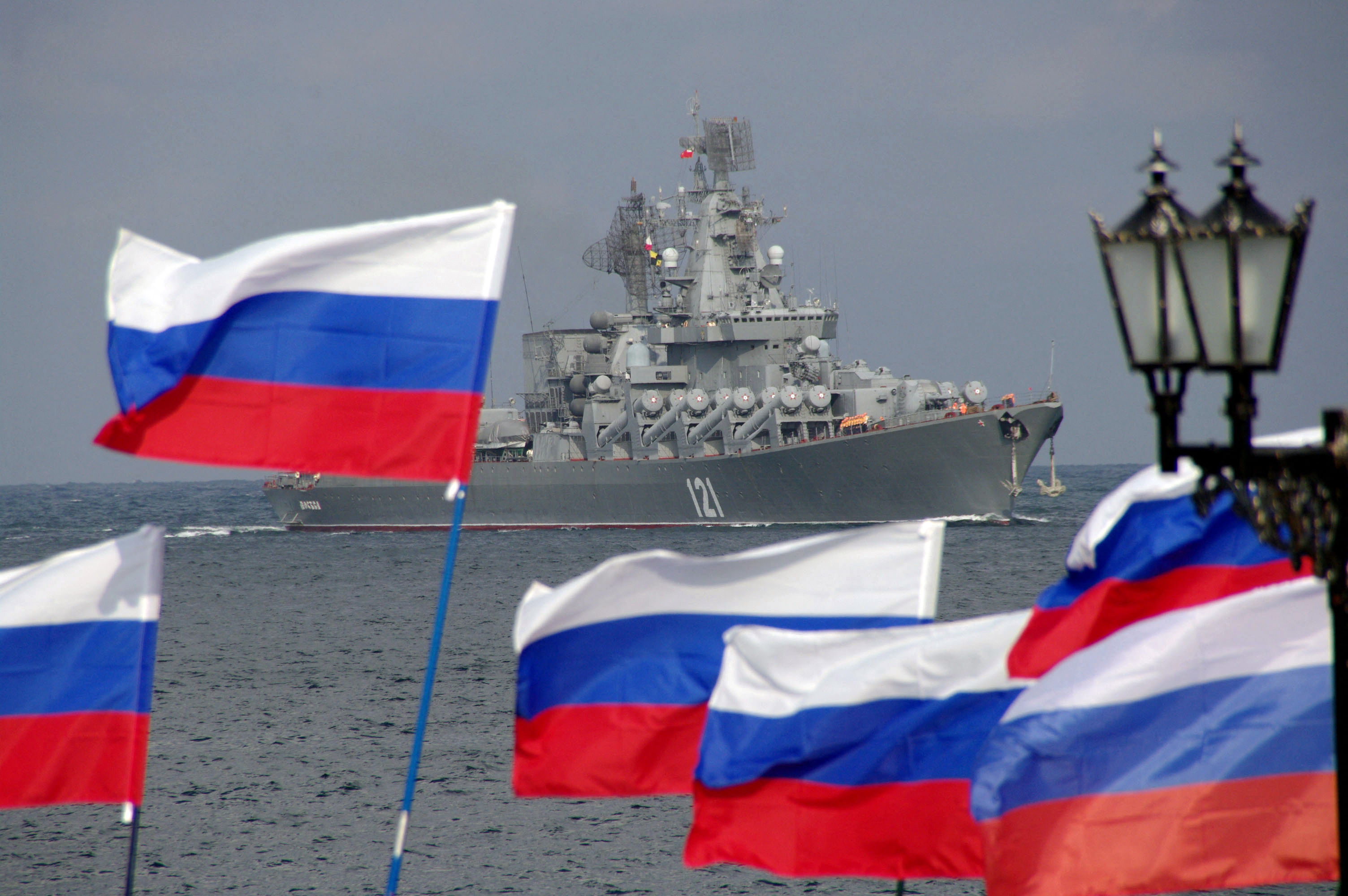
Another Russian Black Sea Fleet vessel was reportedly damaged in annexed Crimea this week, according to a video circulating on Telegram showing a warship engulfed in smoke.

If confirmed, it would be the second Black Sea Fleet ship to be damaged in the space of a few days.

On Friday, the Crimean Wind Telegram channel shared photos and videos that appear to show plumes of black smoke rising from a vessel. It reported that a Russian Buyan class M corvette Grad, which is equipped with a Kalibr system, was damaged.

However, according to Ukrainian military news outlet Defense Express, the vessel in the videos circulating online is a Russian Black Sea Fleet patrol ship.

The videos were also shared on Telegram by an advisor to the mayor of Mariupol, Pyotr Andryushchenko. Newsweek couldn’t independently verify the authenticity of the images and videos.

Earlier on Friday, locals reported hearing a loud explosion near the port of Sevastopol in Crimea.

“A Russian ship blew up in occupied Sevastopol. Even in the center of Sevastopol, a loud explosion was heard, car alarms went off,” wrote Andryushchenko.

Strikes in Crimea, Russia’s central logistics hub for its forces in southern Ukraine, have become routine in recent months amid Kyiv’s counteroffensive to reclaim territory occupied by Russian forces. Attacks have struck military targets in a push to weaken Moscow’s defenses and disrupt Russia from transporting equipment, weapons, and troops from mainland Russia into the peninsula.

Russian President Vladimir Putin‘s Black Sea Fleet has been targeted in a number of strikes.

Russian officials haven’t commented on the reports that a Black Sea Fleet vessel was damaged on Friday.

Newsweek has contacted Russia’s Defense Ministry via email for comment.

The reports come after Ukrainian navy spokesperson Dmytro Pletenchuk said Wednesday that Russia’s Pavel Derzhavin patrol vessel was struck in the southern peninsula.

“You are the first to whom I officially confirm today that it was damaged. I cannot provide you with any information regarding the circumstances of this, let’s say, incident,” Pletenchuk told Radio Svoboda, the Russian service of Radio Free Europe/Radio Liberty.

The Black Sea Fleet had obtained the patrol ship Pavel Derzhavin in 2020, according to Russia’s state-run news agency Tass.

Amid a string of attacks on Crimea by Ukraine, satellite images dated October 1 and 2 showed that Russia’s Black Sea Fleet is repositioning from the port of Sevastopol to Novorossiysk in Krasnodar Krai in southern Russia and the Russian naval port in Feodosia on the annexed peninsula.

Do you have a tip on a world news story that Newsweek should be covering? Do you have a question about the Russia-Ukraine war? Let us know via worldnews@newsweek.com.
Update 13/10/23 at 6:35 a.m. ET: This article was updated with additional information.

Russia’s likely death toll in Ukraine revealed in government filing

0

Russia’s proposed 2024 budget allocates funding to the families of 102,700 military personnel killed in Ukraine, giving insight into Moscow’s likely death toll in Russian President Vladimir Putin‘s war in Ukraine that began in February 2022.

The figures, which have not been independently verified by Newsweek, were reported on Thursday by independent Russian news outlet Mozhem Obyasnit, which analyzed Russia’s federal budget draft for 2024 to 2026. The publication notes that in addition to one-time insurance payments for military personnel killed in Ukraine, relatives also receive monthly compensation of 21,922.12 rubles ($225) from the Social Fund of Russia.

For the 2024 budget, the government allocated 16.335 billion rubles ($168,335,278) to relatives of military personnel who were injured or died. Of this figure, 9.987 billion rubles ($102,917,932) is allocated for monthly payments to the relatives of soldiers who experienced trauma.

The remaining budget—5.798 billion rubles ($59,749,491)—is to be paid to the families of killed military personnel, with 550 million rubles ($5,667,854) set aside to repair homes, if the killed serviceman was previously the breadwinner of the family.

The remaining 5.248 billion rubles ($54,081,637) of the budget, divided by the government’s monthly payment of 21,922.12 rubles ($225), is enough to pay the families of 239,300 killed military personnel, Mozhem Obyasnit reported, noting that the budget includes personnel killed in other conflicts as well as Ukraine.

According to the publication, the government’s expenses more than doubled compared to 2022, and the difference of 2.250 billion rubles ($23,151,125.25), divided by the monthly payment, suggests Russia will need to pay the families of 102,700 military personnel killed in Putin’s war in Ukraine.

“According to the authorities’ forecasts, 100,000 Russian military personnel will die within two years of the [war],” Mozhem Obyasnit reported.

Newsweek has contacted Russia’s Defense Ministry via email for comment.

Russia’s death toll continues to rise amid Ukraine’s grinding counteroffensive to recapture its occupied territories. According to figures released by the General Staff of the Armed Forces of Ukraine on Friday, Moscow lost 1,030 soldiers over the past 24 hours, bringing the total to 285,920.

Estimates of casualty figures vary, with Kyiv’s figures usually exceeding those of its Western allies.

Russia itself rarely releases figures on troop losses. In September 2022, Russian Defense Minister Sergei Shoigu said 5,937 Russian troops had been killed in the war in Ukraine since late February 2022.

A joint investigation by BBC‘s Russian Service and independent Russian news outlet Mediazona on Friday has so far identified the names of 34,412 Russian military personnel who have died in the war in Ukraine. It states that actual number of losses is higher than the figures stated in the investigation.

Ukraine also avoids publishing casualty figures for its own forces. However, Western intelligence estimates suggest they are also substantial. In April, a leaked U.S. Defense Intelligence Agency assessment estimated that Kyiv had suffered 124,500 to 131,000 casualties, including 15,500 to 17,500 dead and 109,000 to 113,500 wounded.

Do you have a tip on a world news story that Newsweek should be covering? Do you have a question about the Russia-Ukraine war? Let us know via worldnews@newsweek.com.

Why Russia’s recent lack of air strikes should terrify Ukraine

0

Russia is likely stockpiling missiles to preserve them for winter attacks on Ukraine, according to British intelligence.

The U.K. Ministry of Defense (MOD) said in an intelligence update on Friday that Russian Air Force Long Range Aviation (LRA) aircraft have not conducted a strike against Ukraine for three weeks, since September 21.

That’s despite Kyiv continuing with its grinding counteroffensive to reclaim the territories seized by Russian forces in the ongoing war. Ukraine’s counteroffensive is now in its fifth month, with particularly heavy clashes taking place along the front lines in the Donetsk and Zaporizhzhia regions.

“While such breaks have not been unusual, the last similar break in strikes occurred between 9 March and 28 April 2023, a period of 51 days,” defense officials said.

The British MOD said that in that instance it was likely that LRA had almost depleted its stocks of capable AS-23 missile munitions following its winter campaign against Ukrainian critical national infrastructure.

Putin ramped up missile attacks on Ukraine’s infrastructure last winter, causing residents to be disconnected from the electricity grid, with those in Kyiv, Odesa, and western Ukraine worst affected.

“This time, it is likely that Russian LRA are preserving existing stocks of AS-23 missiles as well as using this pause to increase useable stocks in anticipation of further heavy strikes against Ukraine over the winter,” defense officials said.

The intelligence update noted that recently, Russia has focused its airstrikes against grain-related facilities across the south of Ukraine, using SHAHED one-way-attack uncrewed aerial vehicles.

“This included strikes against Ukrainian Danube River ports, which likely required a high level of accuracy due to the target’s proximity to the Romanian border,” it said, adding that Russia likely used its SHAHED one-way-attack uncrewed aerial vehicles on these targets because of their better accuracy over other types of air-launched missiles.

Newsweek reached out to Russia’s Defense Ministry via email for comment.

Ahead of a possible winter blitz by Russia on Ukraine’s critical infrastructure, Oleksiy Chernyshov, the head of Ukraine’s state-owned energy giant Naftogaz, told Newsweek last month that Kyiv is “more prepared” than it was in 2022.

“We expect Russia to continue serious missile attacks and drone attacks on our energy and infrastructure objects,” Chernyshov said. “Their task is to deprive Ukrainians of basic services in heating, gas supply, electricity supply and others, and to actually target their morale and emotions.”

“Ukrainians are more prepared,” Chernyshov said. “They are more protected. We have prepared certain protections for our assets: energy production, gas distribution, gas storage, oil storage, oil refineries.”

“Russia is also prepared. Both sides are smarter after the previous winter. The Russians will prepare more sophisticated attacks…They are using more sophisticated methods, so the risk is high,” he added.

Do you have a tip on a world news story that Newsweek should be covering? Do you have a question about the Russia-Ukraine war? Let us know via worldnews@newsweek.com.

Hezbollah hypes "vision and plan" for Hamas-Israel War

0

Hezbollah’s deputy chief Sheikh Naim Qassem on Friday touted the Lebanese militant group’s “plan and vision” for further involvement in the war between Israel and Hamas, as analysts raise alarms about the potential of regional destabilization if additional parties join the conflict.

On October 7, Hamas led the deadliest Palestinian militant attack on Israel in history. Israel subsequently launched its heaviest-ever airstrikes on Gaza. As of Friday, more than 1,300 people had been killed in Israel, the Associated Press reported. At least 1,799 people had been killed in Gaza, according to authorities there, the AP said, citing the Gaza Health Ministry.

Israeli Prime Minister Benjamin Netanyahu has said his country is “at war” and has cut off supplies of food, fuel, electricity and medicine to Gaza. Israel has called up 360,000 army reservists as it prepares for a possible ground offensive into the territory, which has an estimated population of around 2.3 million.

Hezbollah, which maintains significant political power in Lebanon and is backed by Iran, has repeatedly praised the Hamas assault on Israel and voiced its staunch support for Palestinians. The group has already exchanged multiple barrages of artillery with the Israeli military since the Hamas attack. Lebanon borders Israel to the north and officially views Israel as an enemy state.

During a pro-Palestinian rally in Beirut’s southern suburbs, Qassem suggested to the crowd that Hezbollah was prepared to join the war, insisting that the Lebanese militant group does not fear U.S. warnings.

“We in Hezbollah are contributing to the confrontation and we’ll contribute to it within our vision and plan,” the Hezbollah leader said, Lebanese news site Naharnet reported.

“We are following up on the enemy’s step, we are maintaining full readiness and when the time comes for any action we will do it,” he added, rejecting calls for Hezbollah to remain out of the conflict.

He said, “Asking us not to interfere in the battle, will not affect us,” adding that “Hezbollah knows its duties.”

“Your battleships do not interest us, nor do your statements frighten us,” Qassem said, referring to the USS Gerald R. Ford Carrier Strike Group which the U.S. Defense Secretary Lloyd Austin deployed in the Mediterranean in the wake of the Hamas attack.

Newsweek reached out to the State Department for comment on Qassem’s remarks. Previously in a Monday email, a State Department spokesperson told Newsweek that Hezbollah’s involvement would negatively impact Lebanon.

“Any decision by Hezbollah or other actors to drag Lebanon into this conflict would have terrible consequences for the Lebanese people. They deserve better,” the spokesperson said.

Danny W. Davis, professor of the practice in homeland security at Texas A&M University, told Newsweek that Hezbollah’s capabilities are significantly superior to Hamas.

“Hezbollah is a much stronger, and larger organization, as you know centered in Lebanon. The support they receive from Iran easily outstrips that the Iranians provide Hamas. Hezbollah possess a lot of conventional weapons and have the soldiers to use them. They also have a type of longer-range missile that is capable of hitting any target in Israel,” he said.

The professor said that he would expect the State Department is “working through” allies to explain to Iran’s diplomats “the cost they will pay should Hezbollah, or Iran directly enter the fray.”

“I believe Hezbollah will do exactly what the Iranian leaders order them to do,” Davis said.

Avi Melamed, a former Israeli intelligence official who served as senior Arab affairs adviser to multiple mayors of Jerusalem, warned in a Friday opinion article for The Hill that Hezbollah getting further involved in the war would “destabilize more than just Israel.” Melamed pointed to Lebanon’s ongoing economic crisis and Hezbollah’s precarious position within the country, predicting that the group’s involvement could potentially result in “civil war.”

Hilal Khashan, a professor of political science at the American University of Beirut, dismissed Hezbollah’s Friday remarks as “sheer rhetoric” to placate its supporters, who strongly back the Palestinian people.

“Hezbollah is dissociating itself from the war between Israel and Hamas. It displayed its solidarity with Hamas in minor cross-border exchanges of fire with the Israelis,” Khashan told Newsweek in a Friday email.

Later on Friday, Hezbollah announced that it had launched strikes on several points in Israel. The group said the attacks came in response to Israeli shelling of south Lebanon.

Separately, the Lebanese military said in a statement that “the Israeli enemy targeted an unoccupied military observation tower in the vicinity of the town of Alma Al Shaab, used by the Lebanese Army on an ad-hoc basis during the execution of security missions and measures. No injuries were reported among the military personnel.”

Previously on Sunday, Hashem Safi al-Din, the head of Hezbollah’s Executive Council, suggested that the group would become further involved in the escalating conflict.

“The responsibility obliges all the sons of our nation not to be neutral and we are not neutral,” Safi al-Din said at a pro-Palestinian rally in Beirut, Lebanese news site Naharnet reported.

“It is our right to target the enemy that is still occupying our land and the Israelis must read this message well,” he said.

Hezbollah and Israel fought a war in 2006 that lasted 34 days. The conflict is estimated to have left some 165 Israelis and more than 1,100 Lebanese dead.

Update, 10/13/2023 at 12:27 p.m. ET: Additional information about Hezbollah and Israeli attacks was added.

Update, 10/13/2023 at 3:12 p.m. ET: Comment from an additional analyst was added.

Coffee prices could rise due to loss of insects

0

Loss of essential pollinator insects because of the changing climate could lead to some of our favorite treats getting a lot more expensive, research has found.

Various plant crops such as coffee, cocoa, watermelon and mango are under threat because of declining pollinator biodiversity—particularly in the tropics—as a result of climate change and agricultural land use change, a new study in the journal Science Advances reveals.

Areas that will be worst affected by this pollinator loss include sub-Saharan Africa, northern South America and Southeast Asia, which is where coffee and cocoa plants are primarily grown, the researchers’ model shows.

“We investigated how pollinator abundance changes under agriculture and climate change,” Tim Newbold, a principal research fellow in genetics, evolution and environment at University College London and co-author of the paper, told Newsweek.

He continued: “Then comparing places where we estimate large declines in pollinator abundance with where we grow crops that need animals for pollination, we estimate where there may be risks to the production of these crops. Our results reveal that areas where we grow coffee and cocoa are expected to be strongly affected.”

If these crops become less and less abundant with climate change, they may get increasingly expensive if demand outpaces supply.

“It would be difficult to attribute any changes in coffee/cocoa prices that we have seen to pollinator losses versus other factors, such as effects of weather/climate change or economic effects,” Newbold said. “However, if we lose pollinator abundance in the future, as our results suggest we will, we would expect increases in the prices of crops like coffee and cocoa.”

While coffee appears to be declining in price, it is now more expensive than it was in 2019 and 2020.

The loss of pollinators in the tropics and around the world will have wide-reaching impacts on millions of plants. About 75 percent of crops rely to some degree on animal pollinators.

“Pollinator decline is a serious threat to food security and nutritional well-being,” Siobhan Maderson, a research associate in human geography at Cardiff University, told Newsweek.

She went on: “While people will not starve in the context of declining pollinators—most of the world’s key sources of caloric input are non-pollinator-dependent, including wheat, maize and rice—most of the key crops which are economically valuable for producers, and nutritionally important to people worldwide, are pollinator-dependent. These include many fruits, vegetables, nuts, spices and coffee.”

Maderson said cocoa and coffee, among other crops, suffer from other challenges such as pests, fungal infections and climate change.

“There are also symbiotic challenges threatening global crops, as climate change is a threat to pollinators and is also associated with increasing pests that damage crops,” she said. “Industrial food production increasingly relies on managed pollination. However, this is highly risky, due to a decreasing variety of pollinators being relied upon.”

Researchers are hoping to find ways to protect pollinators from the changing climate and the impact of widespread agriculture in order to preserve the crops we know and love. This is important not only for our consumption of these crops but also for the small-scale farmers whose incomes rely on selling these crops around the world.

“To support pollinator well-being, there are several important changes needed: ensure diverse, healthy habitat for pollinators [and] incorporate agroecological practices into food production, such as including mixed cropping and encouraging diverse small-scale production, which is associated with increased biodiversity amidst food-producing landscapes,” Maderson said.

She said tropical deforestation is also a serious risk to pollinators and coffee crops as well as other tropical crops, as mixed landscape use is associated with higher biodiversity and pollinator activity.

“Last, but definitely not least, everyone should do everything in their power to stop climate change, as this is a serious threat to our food system, both on its own and in conjunction with other challenges to our food supply, such as pollinator decline,” she said.

Do you have a tip on a science story that Newsweek should be covering? Do you have a question about pollinators? Let us know via science@newsweek.com.

Has Putin named his successor? What we know

0

Secrecy surrounding Vladimir Putin and the Kremlin has fertilized misinformation surrounding the Russian president, from the state of his health to the claims of body doubles hired to protect him.

His health was said to have taken a particularly sharp turn recently, with claims this week again circulating that Putin was dying and had used doppelgangers in an attempt to disguise his ailing condition.

Headlines appeared in several prominent outlets online that his doctor had predicted “Putin’s imminent death amid a sharp deterioration in his health.”

The claim was from General SVR, a Telegram channel that has had multiple stories about Putin’s health and his grip on power, often attributed to anonymous sources without verifiable information.

“‘There is a general understanding that for some time it has been possible to use a double of the president after the death or removal from power of the real Vladimir Putin,” General SVR said.

“Almost all interested parties are ready to rally around a double who can be controlled; the only problem is who will control the double, and this requires mutual trust, which simply does not exist.”

The Telegram channel claimed Putin’s “inner circle” had tried to create a consensus around the idea of the “continuation of the Putin regime after Putin,” speculating that Secretary of the Security Council of the Russian Federation Nikolai Patrushev was being prepared to become leader.

In a later post, General SVR said it was Putin’s wish that Prime Minister Mikhail Mishustin take over but that Patrushev was the favored candidate by Russia’s other top officials.

Much of the speculation about Putin’s health until now has been based on video footage of him sitting or moving awkwardly, which some have attributed to a range of illnesses from terminal cancer to Parkinson’s.

Some of the rumors have been strengthened, if not proved, by other perhaps more reliable sources. Three intelligence leaders told Newsweek in July last year that a classified U.S. report said Putin had undergone treatment in April 2022 for advanced cancer.

The same year, The Moscow Times cited an investigative report by Proekt Media that said Putin was accompanied by doctors, including a thyroid cancer surgeon, on trips to his residence in Sochi from 2016 to 2019 and that doctors “may have performed surgery” on him in November 2016.

However, the recent report that Putin is at death’s door, with succession plans in motion, has not been corroborated by other sources and was posted without any verifiable evidence.

While it’s unlikely that the Kremlin would volunteer information about Putin’s health if he were struggling, the lack of decent data or proof to support General SVR’s claims, particularly given its track record for these kinds of rumors, strongly suggests this latest story should be treated with skepticism.

Other unevidenced claims that General SVR has shared included how last year Putin fell down a flight of stairs and soiled himself, that he faced an assassination attempt in Moscow, and that he was due to undergo emergency colon surgery in December.

Newsweek has reached out to the Kremlin for comment.

Israel and Hamas use heartbreaking baby pictures in battle for support

0

After the State of Israel’s official X, formerly Twitter, account began promoting an ad showing a dead baby, allegedly killed by Hamas militants, the Palestinian group released a video of its own—showing what appeared to be Hamas fighters fondly taking care of a young child and a baby.

Hamas, which the United States designates as a terrorist organization, led the deadliest Palestinian militant attack on Israel in history on October 7. As of Friday, more than 1,300 people had been killed by Hamas in Israel, the Associated Press reported. At least 1,799 people had been killed in Gaza in Israeli operations, the AP said, citing the Gaza Health Ministry.

Israeli Prime Minister Benjamin Netanyahu has said his country is “at war” and has cut off supplies of food, fuel, electricity and medicine to Gaza. Israel has called up 360,000 army reservists as it prepares for a possible ground offensive into the territory, which has an estimated population of around 2.3 million.

The newly released Hamas propaganda video, which was sent to Newsweek by the group’s media wing, purported to show militants taking care of young Israeli children who had been abducted during the group’s surprise assault on Israel on October 7. Claims that Hamas militants had “beheaded” Israeli babies have featured prominently in the international discussion about the attack over the past several days—with President Joe Biden suggesting he’d seen such images before the White House later walked back the claim.

In the clip, militants have a young child and a baby in their care. They appear to be playing with the two children, rocking the baby in a carriage and holding the other child on their laps. In one shot, a militant holds both children, one in each arm, as he also has a large gun strapped to his body.

Earlier on Friday, Newsweek observed the State of Israel’s official account on X, which has more than 1.3 million followers and is managed by the Israeli Foreign Ministry, promoting an ad of a photo purportedly showing an infant victim of the incursion by Hamas.

The description accompanying the photo, which appeared on users’ X feeds from the Israel account, states: “This is the most difficult image we’ve ever posted. As we are writing this we are shaking. We went back and forth about posting this, but we need each and every one of you to know. This happened.”

The photo, which readers may find upsetting, shows an image of a baby lying in blood in what appears to be a hospital setting, with its face blurred.

The word “Ad” appears in the top right-hand corner of the post, suggesting that it was paid for by the Israel account to appear in social media users’ timelines, though Newsweek has not been able to confirm this. Newsweek has contacted X and the Israeli government for comment via email. This article will be updated if either responds.

The gruesome image promoted by Israel on social media and the apparent response by Hamas in the newly released video highlight the efforts by both sides to promote their narrative about the conflict. Many quickly dubbed the Palestinian group’s video “propaganda,” while critics of Israel have slammed the reports of infants being beheaded as an effort to further stigmatize Hamas in the eyes of an international audience.

Whether Hamas militants actually beheaded Israeli infants is unclear. The Hamas attack did leave many young children and hundreds of other civilians dead. Israel’s military response in Gaza has also resulted in significant civilian loss of life, including the deaths of numerous children.

“I never really thought that I would see, have confirmed, pictures of terrorists beheading children,” Biden said Wednesday. The president’s remark came after Israel news channel i24’s reporter Nicole Zedek said during a live broadcast that she had spoken to Israeli soldiers who had seen the corpses of babies that had been beheaded.

The White House later clarified that Biden’s comment was based on news reports, not images he’d actually viewed himself, according to The Washington Post. Israel Defense Forces spokesperson Major Doron Spielman told NBC News that the specific report could not be confirmed.

Slain neurosurgeon’s Detroit mansion hits the market for $2.5 million

0

A mansion that was the site of a prominent neurosurgeon’s murder in Detroit has been listed on the market for $2.5 million.

Devon Hoover, who worked as a neurosurgeon for years before his death, was found naked and shot to death in his home this spring.

His body was found in a crawl space within the attic of the mansion during a welfare check in April. He was found to be shot twice in the back of the head and wrapped in a plastic sheet before authorities found him.

A few days after he was found dead, his car was located on the west side of Detroit.

Police say the doctor, who was employed by St. John Ascension, lived alone and was single, and now the seven-bedroom mansion will be available for potential homebuyers.

In addition to seven bedrooms, the mansion boasts four and a half bathrooms and is located in the Boston-Edison District.

The house itself sits over 11,000 square feet and includes a ballroom along with a 1,300 square foot carriage house with two bedrooms, two bathrooms and a space for three cars.

There’s also a greenhouse for potential homebuyers to explore if interested in the $2.5 million property.

Real estate agents expect a combination of market factors and the story behind the home could cause the house to be sold for a discount, however.

“It’s a big house and not everybody can afford it,” Tom Nanes, of Community Choice Realty told Realtor.com. “Right now, the market is bipolar. It’s all over the place.”

And since homebuyers will know of the tragedy that took place within the mansion, they might not be as eager to fork over their money.

“This may be too soon for the creepy factor,” Names said. “Some people like notoriety. Some people can’t deal with it.”

Hoover originally bought the mansion in 2008. At that time, it cost just $750,000.

While there’s been no immediate arrest of anyone related to Hoover’s murder, police say they have a suspect and are “very confident” they will be able to provide justice for the family.

“We are very confident we are going to bring this family justice. We are confident that we are aware of the circumstances. We are confident in our suspect,” Detroit Police Chief James White said last month.

Acquaintances of Hoover’s were shocked by the violent killing, and his mother died just a few days after he was murdered.

“This man is nonconfrontational. He wouldn’t even evict a tenant who hadn’t paid in a year. This man had no enemies,” Hoover’s neighbor Jeff Cowin told ABC affiliate WXYZ.

“That man was an angel,” another neighbor shared, according to Fox 2. “He was beautiful. Everybody was shocked. My phone has been blowing up all night, I was like, no, no, no.”

The Home For Sale

In the aftermath of the tragedy, the mansion will find a new owner for its currently empty 26 rooms all across the two-acre lot.

The new residents can expect a library, multiple dining rooms and various other rooms for multiuse inside the mansion that rests behind an immense green lawn and entryway.

Chandeliers and dark wood frame the antique dwelling when visitors first arrive in the mansion, and a long-winded stairwell leads to several of the other rooms, which include dining rooms, living rooms and historic fireplaces.

Video shows George Santos rage at pro-Palestinian protester: "Human scum"

0

Embattled U.S. Representative George Santos was caught in a screaming match in the halls of the Longworth House Office Building in Washington, D.C., on Friday after a protester grilled the congressman about his views on the Israeli-Palestinian conflict.

It’s unclear what moments led to the heated exchange, but the New York Republican is caught on video claiming that the protester—who was identified by NBC News’ Sahil Kapur as Shabd Singh, a Jewish American from Washington—accosted him while the congressman was holding a “2-month-old baby.” New York Sun correspondent Matt Rice posted a photo to X, formerly Twitter, Friday afternoon of Santos holding a baby after leaving Representative Tim Burchett’s office.

In a video captured by Kapur and shared to X, Santos is seen directing Capitol police toward Singh while the protester asks Santos what he is doing to “call for the end” of the Israeli military’s actions in Gaza. Israeli Defense Minister Yoav Gallant has called for a complete siege of the region after the Palestinian militant group Hamas launched a deadly surprise attack against Israel on October 7.

Singh told Kapur that he was “critical” of Israeli policies.

As Singh continues to ask questions, Santos raises his voice and points violently toward the protester, telling him that it is “abhorrent” to “try to defend” Hamas’ attack. At one point, a Capitol police officer signals for Santos to back away from Singh’s face.

“You are a terrorist sympathizer,” Santos yelled as Singh continued to question him. “You are human scum.”

As Santos walks down the hallway while being followed by a mob of media personnel, Singh shouts out, “You’re a coward.” The congressman responded, stopping briefly to turn back toward Singh, “You have no business in this building defending terrorists.”

Newsweek reached out to Santos’ office for more information via email on Friday.

In a statement shared to X Friday evening, Santos referred to Singh as “breathing stains on society” and again accused him of sympathizing with “Hamas terrorists.”

“This afternoon, a pair of these breathing stains on society accosted me,” read the statement. “A Hamas supporter and their partner cornered me and berated me with a two-month-old baby in my arms. This heinous behavior has no place in our society, let alone in our nation’s Capitol.”

Santos has attracted plenty of attention in his freshman year of Congress. On top of being caught lying about his resume while running for office last year, the Republican is also facing a total of 23 federal charges, accused of committing fraud and identity theft while campaigning. He pleaded not guilty to the first 13 charges filed against him.

Santos has also been accused of misleading voters about his religious background, claiming on his campaign website that his maternal grandparents escaped “Jewish persecution” during WWII. The congressman later corrected himself to say he meant he was “Jew-ish,” and was actually raised in a Catholic family.

Throughout the scandals, Santos has repeatedly ignored calls to resign from both Republicans and Democrats. After being hit with additional federal charges earlier this week, the congressman told ABC News that he intends to fight his case until “the bitter end.”

“I’m strong in my convictions that I can prove my innocence,” he added.

Update: 10/13/23, 6:42 p.m.: This article was updated with additional background information.